IEC 60529 is the international standard that defines the Ingress Protection (IP) code — the two-digit classification that tells you how well an enclosure protects its contents against dust and water. If you specify, design or buy aluminum enclosures for electronic equipment, IEC 60529 is the reference behind every "IP67" or "IP68" rating printed on a datasheet. The current consolidated edition is IEC 60529:1989+A1:1999+A2:2013 (Edition 2.2), maintained by IEC Technical Committee 70, and a third edition is already under development. This guide explains what the standard covers, how to read an IP code correctly, and how to turn that information into practical enclosure design decisions.
What Exactly Is IEC 60529?
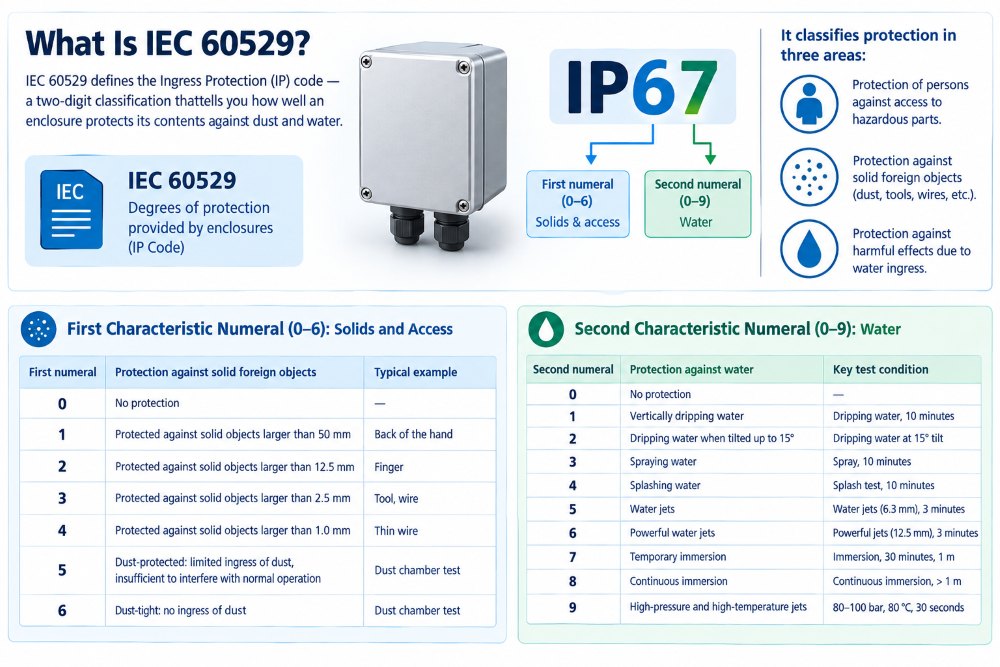
IEC 60529, "Degrees of protection provided by enclosures (IP Code)", is an international standard prepared by IEC Technical Committee 70. It classifies the degree of protection that an enclosure provides in three areas:
- protection of persons against access to hazardous parts inside the enclosure;
- protection of the equipment inside the enclosure against the ingress of solid foreign objects such as dust, tools and wires;
- protection of the equipment inside the enclosure against harmful effects due to the ingress of water.
The standard applies to enclosures for electrical equipment with a rated voltage not exceeding 72.5 kV. In practice, that covers almost everything electronics engineers work with — from small instrument housings and sensor boxes to industrial control enclosures and 19-inch chassis — which is why IEC 60529 is one of the most frequently referenced standards in enclosure engineering.
The first edition was published in 1976. The second edition followed in 1989, with Amendment 1 in 1999 and Amendment 2 in 2013, which added a new water-protection degree, IPX9, for high-pressure and high-temperature water jets. The current consolidated version combines the base document and both amendments: IEC 60529:1989+A1:1999+A2:2013, Edition 2.2. Because the standard is actively maintained, a third edition is currently in preparation by IEC TC 70 and is expected to be published around 2027. Before you commit a rating to a drawing or a datasheet, it is always worth checking the official IEC page for the current status.
How the IP Code Works
An IP code is written as "IP" followed by two characteristic numerals and, where needed, one or two letters. The first numeral indicates protection against solid foreign objects and access to hazardous parts; the second numeral indicates protection against water. Understanding both scales is the key to reading any IP rating correctly.
First Characteristic Numeral (0–6): Solids and Access
| First numeral | Protection against solid foreign objects | Typical example |
|---|---|---|
| 0 | No protection | — |
| 1 | Protected against solid objects larger than 50 mm | Back of the hand |
| 2 | Protected against solid objects larger than 12.5 mm | Finger |
| 3 | Protected against solid objects larger than 2.5 mm | Tool, wire |
| 4 | Protected against solid objects larger than 1.0 mm | Thin wire |
| 5 | Dust-protected: limited ingress of dust, insufficient to interfere with normal operation | Dust chamber test |
| 6 | Dust-tight: no ingress of dust | Dust chamber test |
Second Characteristic Numeral (0–9): Water
| Second numeral | Protection against water | Key test condition |
|---|---|---|
| 0 | No protection | — |
| 1 | Vertically dripping water | Dripping water, 10 minutes |
| 2 | Dripping water when tilted up to 15° | Dripping water at 15° tilt |
| 3 | Spraying water | Oscillating spray up to 60° from vertical |
| 4 | Splashing water | Splash from all directions |
| 5 | Water jets | 6.3 mm nozzle, 12.5 l/min |
| 6 | Powerful water jets | 12.5 mm nozzle, 100 l/min |
| 7 | Temporary immersion in water | 1 m below surface, 30 minutes |
| 8 | Continuous immersion in water | Conditions agreed between manufacturer and user (usually deeper and/or longer than IPX7) |
| 9 | High-pressure and high-temperature water jets | Added by Amendment 2 (2013); hot water at high pressure for washdown environments |
Optional Letters
Two letters can be appended to an IP code. An additional letter (A, B, C or D) indicates the protection of persons against access to hazardous parts when that protection is higher than the first numeral suggests — for example, IPXXB means protected against access by a finger. A supplementary letter (H, M, S or W) gives extra information: H for high-voltage equipment, M for protection against water when the equipment is moving, S for protection when it is stationary, and W for protection under specified weather conditions. For most electronic enclosure specifications, the two numerals are all you need to compare.
What an IP Rating Actually Proves
The most important nuance in IEC 60529 is that an IP code describes how the enclosure performed in a standardized test under specific test conditions — it is not a blanket guarantee for every situation the product will meet in the field. As IEC itself stresses, an IP rating indicates how the product was tested, not the conditions in which it can be used. A few drops of water can be harmless in one device and fatal in another, so the rating alone never tells the whole story.
This matters most at IPX8. Unlike IPX7, which always means 1 m for 30 minutes, IPX8 has no fixed depth or duration in the standard: the manufacturer and the user agree on the test conditions. That is why one "IP68" enclosure may be certified at 1 m for 30 minutes while another is tested at 10 m for 24 hours. Always ask for the exact test conditions behind an IP68 claim — depth, duration and the test report.
It is equally important to remember what the IP code does not cover. Corrosion, UV resistance, mechanical impact, temperature extremes and gasket aging are evaluated under other standards, such as IEC 62208 for empty enclosures and the IEC 61587 series for mechanical structures. An IP68 aluminum enclosure can still fail if the alloy, surface finish or sealing material is wrong for the application.
IP Ratings at a Glance
The bars below show the relative position of the main water-protection and solid-protection degrees defined by IEC 60529, with the ratings most commonly used for electronic enclosures marked. The scale is illustrative — it shows how the test levels in the standard progress, not a measured performance value.
Reading Common Ratings: IP65, IP66, IP67 and IP68
Most outdoor electronic enclosures are specified with one of four ratings:
- IP65 — dust-tight and protected against water jets. The practical minimum for outdoor electronics exposed to rain, such as wall-mounted boxes and sensor housings.
- IP66 — dust-tight and protected against powerful water jets. Suited to washdown environments where equipment is cleaned with pressurized water.
- IP67 — dust-tight and protected against temporary immersion (1 m, 30 minutes). A common choice for outdoor junction boxes and flood-prone installations.
- IP68 — dust-tight and protected against continuous immersion under agreed conditions. Used for submersible devices, underground cable junction boxes and marine electronics.
If the application also involves high-pressure hot-water cleaning — food processing, agriculture and vehicle washdown — the IPX9 degree added in Amendment 2 is the relevant target.
From the Standard to Enclosure Design Decisions
IEC 60529 becomes useful the moment you translate it into design decisions. Based on how waterproof aluminum enclosures are engineered and tested, here are the points that decide whether a design actually reaches its target code:
- Select the target code first, then design to the test. Decide the IP degree from the real exposure — rain, jet wash, temporary flood or continuous immersion — before finalizing geometry. Designing "as waterproof as possible" usually costs more without adding reliability.
- Treat the cover interface as the primary sealing zone. A flat cover with a gasket groove, consistent screw spacing and controlled gasket compression behaves predictably in an IP test; a cover relying on friction alone usually does not.
- Match every opening to the rating. Cable glands, connectors, breathers and buttons must each be rated at least as high as the enclosure code. A single unrated cable entry can drop a design from IP68 to nothing.
- Control the machining of sealing surfaces. Flatness, surface roughness and edge quality on the gasket face directly influence sealing consistency. In CNC machining, this is where tight tolerances actually pay off — at YONGU, CNC machining is held to ±0.05 mm so sealing grooves and mounting faces repeat reliably from sample to batch.
- Plan the verification early. A prototype should go through the relevant dust and water tests under the standard's conditions before tooling is committed. That is a specification problem, not an afterthought.
- Document the agreed IPX8 conditions. If you specify IP68, write the depth and duration into the drawing and the RFQ so the manufacturer and the buyer are testing the same thing.
YONGU's IP-Rated Aluminum Enclosures
YONGU manufactures IP65, IP67 and IP68 aluminum enclosures for outdoor electronics, IoT equipment, junction boxes, battery housings and control systems. The waterproof families — the IP68 L Series and M Series, the IP67 MJ Series, the IP65 MH Series and the die-cast IP68 T Series — are tested against the IEC 60529 requirements, with Bureau Veritas IP68 test reports (1.5 m immersion) available for the L and M series. A good starting point is the IP68 waterproof aluminum enclosure collection, or specific models such as the M01 IP68 unibody enclosure, the MJ03 IP67 IoT gateway enclosure and the MH05 IP65 extruded electronic enclosure.
Because every project starts with a different exposure profile, the YONGU FAQ answers the common IP selection questions, and the IP68 test report can be downloaded from the downloads page. For a deeper comparison of ratings, see the IP Ratings Guide for industrial enclosures. If your application needs a specific code — or a custom size, cutout or finish to meet it — YONGU's engineering team can review the drawing and confirm the practical test path before production.
IEC 60529 FAQ
What does IP67 mean?
IP67 means the enclosure is dust-tight and protected against temporary immersion in water to a depth of 1 m for 30 minutes, as defined in IEC 60529.
Is a higher IP rating always better?
Not necessarily. A higher water numeral usually means a more demanding (and more expensive) sealing design. Choose the rating that matches the real exposure — there is no benefit in paying for IP68 in a dry indoor installation.
Can an IP rating be compared directly with a NEMA Type rating?
No. IP ratings (IEC 60529) and NEMA Type ratings (NEMA 250) are different systems with different tests and are not interchangeable. Use each for the market and application it was designed for.
Does IP68 mean the enclosure can stay underwater forever?
No. IPX8 protection applies to continuous immersion under conditions agreed between the manufacturer and user — for example, 1.5 m for a specified duration. Always verify the tested depth and time for the specific product.
Where can I check the current version of IEC 60529?
The official IEC Webstore page for the standard is the authoritative source for edition, amendments and status.
Sources
Standard reference: IEC 60529:1989+A1:1999+A2:2013 — Degrees of protection provided by enclosures (IP Code), IEC Webstore. IEC TC 70 maintains the standard; a third edition is under development. Company facts (founded 2004, 20+ years in aluminum enclosures, factory in Jiangmen with in-house CNC and anodizing) and the Bureau Veritas IP68 test reports are from the YONGU corporate and certification records.