An outdoor electrical enclosure has to keep working through rain, sun, salt air, and daily temperature swings — and aluminum is the material most outdoor electronics end up in. It conducts heat roughly four times better than steel, weighs a third as much, needs no paint to resist weather once anodized, and can be machined, extruded, or die-cast into the exact shape a cable plan requires. The catch is that aluminum protects equipment only when the grade, finish, seal, and mounting details are chosen for the actual site. This guide covers those decisions in the order they affect service life: environment, rating, corrosion protection, heat, cable entries, mounting, and customization.

Why Aluminum for Outdoor Electrical Enclosures?
Four properties carry the material case. Thermal conductivity for 6063 extrusion runs about 200 W/m·K, against roughly 50 W/m·K for steel and 2–10 W/m·K for ABS or polycarbonate, so an aluminum wall spreads internal heat instead of trapping it at the PCB. Strength-to-weight lets a 2 mm extruded wall carry lid bolts, bracket loads, and wind pressure. The oxide layer that forms within minutes of exposure self-heals when scratched, and anodizing thickens it into a hard finish that needs no repainting. Aluminum is also non-magnetic, useful near antennas and current sensors.
The trade-offs are real. Aluminum is a good conductor, so a metal box must be bonded to the equipment grounding conductor — plastic avoids that step but cannot shield or carry ground continuity. Aluminum sits below stainless and copper in the galvanic series, so bare contact with those metals in a wet joint corrodes the aluminum side, and a raw mill finish stains and pits in coastal air. Each is manageable with the right finish, isolation, and grounding.
Outdoor Environmental Factors
Four stresses act at once. Solar UV degrades gaskets and coatings; the same sun raises internal temperature; wind-driven rain tests every seam; salt or road dust accelerates corrosion at cut edges and threads.
The stress that most often ends an enclosure's life is thermal cycling, not water. A box that gains 25–30 °C by day and loses it at night expands and contracts its walls, lid, and gasket against each other. Aluminum moves about 23 µm per meter per kelvin; EPDM and silicone move far more, so a 200 mm lid sees a relative shift of a few tenths of a millimeter across a daily swing. Repeated cycles shear the gasket in its groove, and because a compressed elastomer takes a permanent set, a seal that passed a factory immersion test can leak in year two. Countermeasures: seat the gasket in a machined groove at 20–30% compression, choose silicone for wide swings and EPDM only for mild climates, and fit a breather membrane so pressure equalizes without admitting liquid. The mechanism is covered in preventing condensation in outdoor enclosures, and the indoor-versus-outdoor distinction in indoor and outdoor enclosure differences.
IP & NEMA Ratings for Outdoor Use
Two rating systems apply and are not interchangeable. IP codes come from IEC 60529: IP65 is dust-tight plus low-pressure jets, IP66 adds powerful directed jets, IP67 covers 1 m immersion for 30 minutes, and IP68 is continuous submersion at an agreed depth and duration. The North American Type system comes from ANSI/NEMA EN 10250-2026, the current edition of the standard formerly numbered NEMA 250, published by NEMA and distributed through ANSI. For outdoor electrical equipment the relevant Types are 3R (rain, sleet, snow), 3S (plus external ice), 4 and 4X (windblown dust and rain, splashing and hose-directed water; 4X adds corrosion resistance), and 6 and 6P (temporary and prolonged submersion).
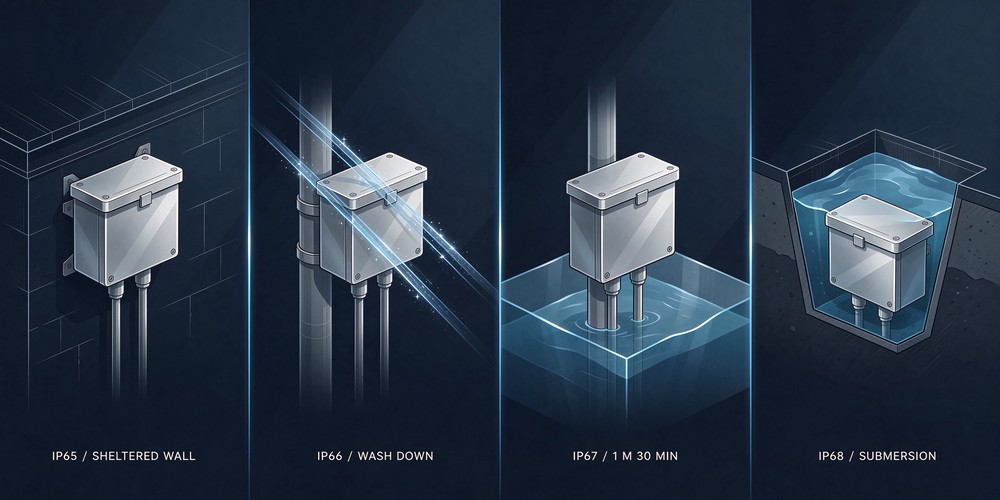
The rule is exposure-driven. A wall box under an eave needs IP65 or Type 3R. An exposed pole or rooftop unit facing driven rain and washdown needs IP66 or Type 4/4X. A box at grade level where water can pond needs IP67. A vault, sump, or buried pit needs IP68 or Type 6P. Compare the middle grades in IP65 versus IP67 for outdoor electronics and IP68-rated outdoor enclosure boxes. A higher number is not automatically better: it usually means a heavier gasket, tighter torque spec, and higher cost.
Aluminum Corrosion Protection Methods
Three finishes carry most outdoor aluminum enclosures. Sulfuric anodizing (Type II) builds an oxide layer of roughly 10–25 µm that can be sealed for color and corrosion resistance. Hard anodizing (Type III) produces a denser 25–50 µm layer with much higher wear resistance. Powder coating over a chromate or chrome-free conversion layer gives color, hides extrusion die lines, and survives impacts better than a thin oxide. Conversion coating alone — typically a chrome-free film per MIL-DTL-5541 Type II — passivates interior surfaces and mating faces rather than serving as a stand-alone exterior finish.
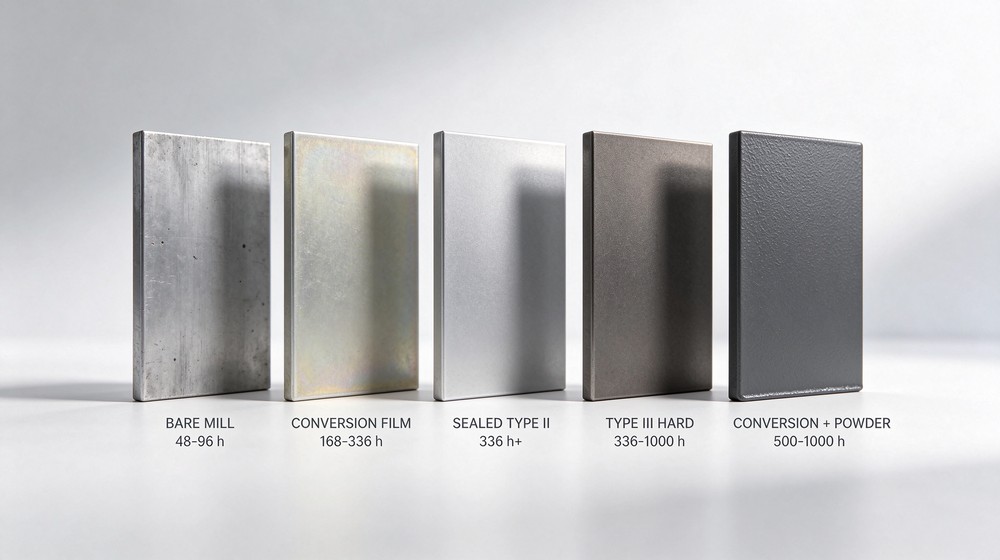
| Finish system | Typical neutral salt-spray endurance (ASTM B117) | Best use |
| Bare mill finish | First pitting within roughly 48–96 h | Sheltered inland, short service |
| Conversion coating only | About 168–336 h | Interior faces, mating surfaces |
| Sealed Type II anodize | 336 h and beyond | General outdoor, inland and mild coastal |
| Type III hard anodize | 336–1000 h | Coastal, abrasive dust, high wear |
| Conversion layer + powder coat | 500–1000 h | Colored exterior, chemical exposure |
These ranges are typical qualification targets under ASTM B117-19 neutral salt fog, not guarantees of service years. Coastal projects should review marine-grade salt-spray protection for coastal electronics, and the galvanic pairing issue with stainless fasteners is covered in preventing corrosion in metals.
Thermal Management in Outdoor Enclosures
Outdoor boxes face a heat load the catalog never shows: solar gain. A dark, sun-facing lid can run 15–20 °C above air temperature, and that surface heat soaks into the same volume the electronics are heating. A first-pass estimate uses ΔT = P / (h × A), where P is internal watts, A the effective exterior area, and h the combined convection-radiation coefficient; for a naturally cooled outdoor box h is commonly taken around 5–10 W/m²·K, so a 20 W load in a 0.1 m² box predicts a 20–40 °C rise before solar gain is added.
What helps, in order of cost: a light or reflective finish; integral ribs or a finned lid that add area without a fan; a sun shield or mounting on the shaded side of a pole; vented breather elements that exclude rain; and only then forced ventilation or a thermoelectric cooler. Heat paths and finned options are detailed in IP68 heat-dissipating aluminum enclosure solutions. Every vent and fan opening trades away part of the IP rating, which is why sealed aluminum with external fins is the usual answer for IP67 and IP68 duty.
Cable Gland & Entry Sealing
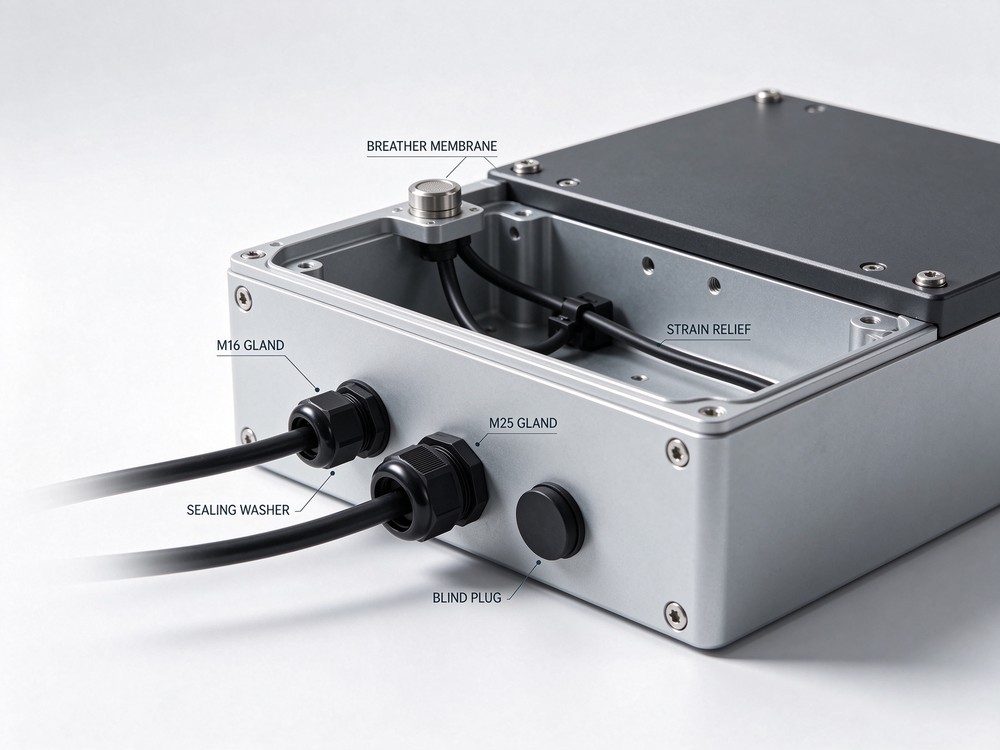
Entries fail before lids do. Size each gland to the cable's actual outer diameter — M12 for roughly 3–6.5 mm, M16 for 4–8 mm, M20 for 6–12 mm, M25 for 10–17 mm — and use a sealing washer against the box face. Nylon glands torque to about 2–5 N·m; metal glands in coastal or washdown service benefit from a thread sealant and a stainless or plated body. Close unused entries with blind plugs; an open knockout is a direct water path. Inside the box, route cables through a strain-relief clip or loop so a pull on the cable does not lever the gland out of its seat, and keep enough bend radius that conductors do not press on the seal. For multiple small cables, a multi-hole insert keeps one entry instead of several oversized holes. Where internal pressure changes with temperature, a pressure-compensation breather element at the highest point prevents the box from drawing moist air past the gasket.
Mounting Options: Wall, Pole, Rack
Wall mounting should use standoff spacers so the back face drains and dries; a box clamped flat against a damp wall traps a water film. Pole mounting needs a two-point bracket so wind cannot rotate the box, with load carried by body bosses rather than the lid. Rack and cabinet mounting applies where an outdoor enclosure holds instruments in a 19-inch stack or is bolted to a skid; there, rail hardware and fasteners should be plated or stainless, the rail grounded where it carries equipment ground conductors, and the assembly tilted so water runs off. In every case leave service clearance wide enough to inspect the gasket and re-torque glands, and add a weep path at the lowest corner if condensation can collect.
Customization for Outdoor Applications
Outdoor projects rarely fit a catalog box exactly, and the custom scope usually covers: cutouts and gland holes positioned to the cable plan; a grounding boss or stud at a clean, unpainted contact point; gasket material selected to the site temperature range; finish and color matched to branding plus solar and corrosion needs; silk-screen labels that survive UV; and mounting flanges, brackets, or pole hardware. Prototype quantities are practical — tooling for extrusion or die-cast bodies is the main non-recurring cost, while CNC-machined cutouts and sheet-metal forms need none. Confirm the drawing set before release: outside dimensions, wall thickness, entry positions and thread, ground point location, gasket groove detail, and the IP rating the assembled unit is expected to hold.
YONGU Outdoor Aluminum Enclosures
YONGU has built aluminum enclosures since 2004, with a 12,000 m² Foshan headquarters and Jiangmen plant, 160+ machines, 14 lines, and 1,000+ molds. The outdoor range covers die-cast and extruded bodies sealed to IP65–IP68 with anodized, painted, or sandblasted finishes. Representative models: the M03 outdoor waterproof equipment enclosure (100 × 50 mm, IP68), the M11 outdoor electrical control enclosure (180 × 70 mm, IP68), the L07C wall-mount project box (160 × 120 mm), and the L09A wall-mounted outdoor enclosure (185 × 135 mm). The full range sits in the outdoor electrical enclosure category, with related options under waterproof junction boxes and aluminum electronics enclosures. MOQ is one unit, samples ship in 5–7 working days, and batch lead time runs 15–20 days; IP, salt-spray, ROHS, and REACH reports are available on request.
Send the site conditions with the drawing. Tell us the exposure (inland, coastal, washdown, buried), the ambient and internal temperature range, cable count and diameters, and the rating you must hold. YONGU will propose the alloy and finish, set gasket material and gland sizes, and confirm mounting hardware — then quote a prototype or production run. Start at the contact page; drawings and reports are on the downloads page.
FAQs
Is aluminum suitable for outdoor electrical enclosures?
Yes, and it is the common choice for IP65–IP68 outdoor electronics. Aluminum resists weather once anodized or coated, conducts heat well, and is light enough for pole and wall mounting. It must be bonded to the equipment grounding conductor, and it should not be left as a bare mill finish in coastal air.
Which IP or NEMA rating do I need outdoors?
Sheltered wall boxes: IP65 or Type 3R. Exposed rain and washdown: IP66 or Type 4/4X. Possible ponding at grade: IP67. Vaults and buried pits: IP68 or Type 6P. Ratings come from IEC 60529 for IP and ANSI/NEMA EN 10250-2026 for the North American Types. The two do not convert exactly.
How long will an anodized aluminum enclosure last outdoors?
The body usually outlasts the seal. Sealed Type II anodize suits general outdoor duty; Type III hard anodize or conversion plus powder coat is the coastal spec. Inspect and replace the gasket on a multi-year interval, and choose silicone where swings are large.
Does an outdoor enclosure need a vent?
A sealed IP67/IP68 box benefits from a breather membrane that equalizes pressure without passing liquid; it reduces gasket stress and condensation. A true open vent gives up the water rating. For heat, external fins or a sun shield beat cutting vents into a sealed box.
Can a metal outdoor enclosure be mounted on a pole?
Yes, with a two-point bracket that prevents rotation and carries load through body bosses. Use plated or stainless fasteners, keep the box off the pole face for drainage, and orient the lid away from prevailing rain.
What is the minimum order for a custom outdoor enclosure?
YONGU starts at one unit for catalog-based configurations with custom cutouts; new extrusion or die-cast tooling adds a one-time cost. Samples typically ship in 5–7 working days, with production runs in 15–20 days.