A NEMA 12 enclosure is an indoor-rated electrical enclosure that protects equipment against circulating dust, lint, fibers, and dripping or lightly splashing non-corrosive liquids. Defined in NEMA 250 — formally redesignated ANSI/NEMA EN 10250:2024 — the Type 12 rating is one of the most common choices for industrial control panels, PLCs, machine-tool controls, and junction boxes inside factories and commercial buildings. Because NEMA 12 is an indoor standard, it is often confused with outdoor ratings such as NEMA 4 or NEMA 4X; this guide explains what NEMA 12 actually covers, where it should and should not be used, and how anodized aluminum enclosures deliver the corrosion margin NEMA 12 environments need.
What Is a NEMA 12 Enclosure?
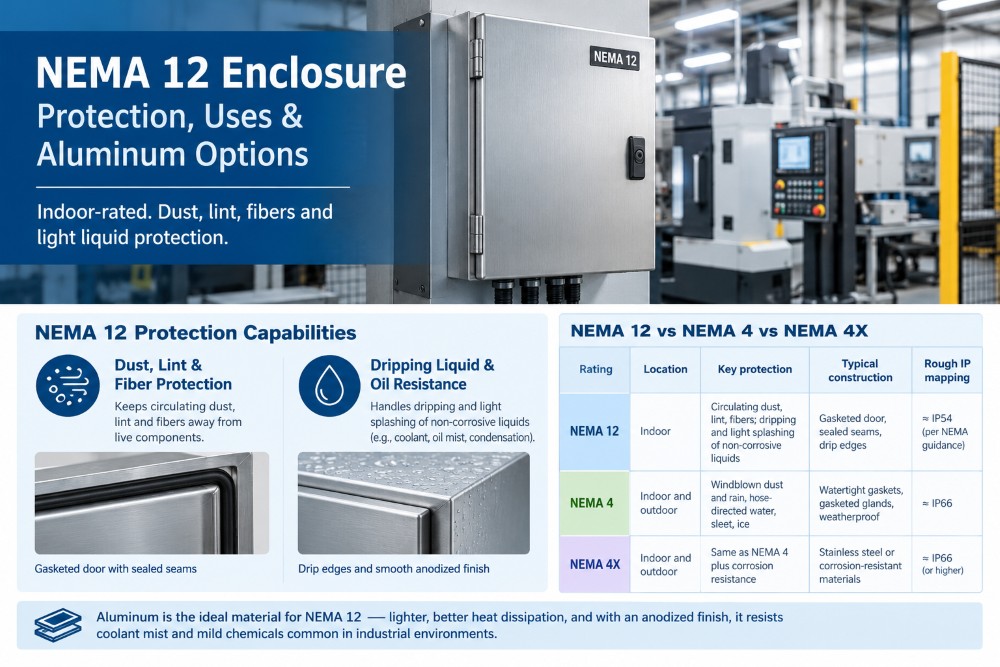
NEMA Type 12 enclosures are intended for indoor use in non-hazardous locations, providing protection against circulating dust, lint, fibers, and the dripping or light splashing of non-corrosive liquids. The requirements are set out in the NEMA enclosure standard (NEMA 250, now published as ANSI/NEMA EN 10250:2024; NEMA 250 remains the common industry term). A compliant Type 12 box is typically gasketed around the door or cover, with seams designed to keep circulating dust and fibers out and with drip protection for light liquid exposure. NEMA 12K is the variant with knockouts provided.
Three practical points define the rating:
- Indoor only — Type 12 carries no outdoor weather rating, no hose-down rating, and no corrosion rating.
- Dust-tight, not waterproof — it blocks circulating dust, lint and fibers; it tolerates dripping and light splashing, not pressurized water or immersion.
- Non-corrosive liquids only — dripping water, coolant splash or oil mist are in scope; aggressive chemicals point to NEMA 4X instead.
Aluminum is the natural material for NEMA 12 applications: it is lighter than steel for panel mounting, dissipates heat from drives and power supplies, and with an anodized finish it shrugs off the coolant mist and mild chemical exposure common on plant floors. For the full background on NEMA enclosure types, see our NEMA enclosure explainer and the NEMA enclosure selection guide.
NEMA 12 Protection Capabilities
Dust, Lint & Fiber Protection
NEMA 12's defining job is to keep circulating dust, lint and fibers away from live components. That covers airborne dust in machine shops, textile lint, cardboard fiber from packaging lines, and the fine particulate that collects inside control rooms. The enclosure achieves this through a gasketed door or cover, sealed seams, and controlled openings — not just a sheet-metal box with a plain cover. When an aluminum enclosure is machined for this duty, the gasket groove and flat sealing face are cut in the same CNC setup as the cutouts, so the seal compresses evenly around the full perimeter. This matters because a NEMA 12 claim is only as good as the gasket line: dust will find a 0.1 mm gap over years of thermal cycling.
Dripping Liquid & Oil Resistance
The second half of the Type 12 definition covers dripping and light splashing of non-corrosive liquids — condensation drips, coolant splash from a nearby machine, oil mist, and the occasional cup of water over a bench. It is not a hose-down rating: pressurized washing, flood, or immersion are outside NEMA 12 scope and require NEMA 4/4X or an IP66–IP68 enclosure. In design terms, drip resistance comes from sloped or lipped edges, drainage paths around the door, and a gasket that seats against a smooth anodized face. On anodized aluminum, the sealed oxide layer (Type II anodize) also resists the mild alkalis and cutting fluids common in metalworking environments, which is one reason anodized aluminum NEMA 12 boxes outlast painted steel in the same machine room.
NEMA 12 vs NEMA 4 vs NEMA 4X
The fastest way to mis-specify an enclosure is to buy an outdoor rating for an indoor problem, or an indoor rating for an outdoor one. The table below compares the three ratings buyers most often weigh against each other.
| Rating | Location | Key protection | Typical construction | Rough IP mapping |
| NEMA 12 | Indoor | Circulating dust, lint, fibers; dripping and light splashing of non-corrosive liquids | Gasketed door, sealed seams, drip edges | ≈ IP54 (per NEMA guidance) |
| NEMA 4 | Indoor and outdoor | Windblown dust and rain, hose-directed water, sleet, ice | Watertight gaskets, gasketed glands, weatherproof | ≈ IP66 |
| NEMA 4X | Indoor and outdoor | Same as NEMA 4 plus corrosion resistance (salt, chemicals) | Stainless steel, fiberglass, or coated aluminum | ≈ IP66 with corrosion resistance |
IP ratings and NEMA ratings are not interchangeable — they test different things, and NEMA adds requirements (lint and fiber, gasket durability, corrosion) that the IP code does not cover. The official NEMA EN P1 white paper maps NEMA types to approximate IP codes, and our NEMA vs IP comparison walks through the mapping in detail. The practical rule for U.S. buyers: indoor plant floor with dust and drip risk → NEMA 12; outdoor or washdown → NEMA 4; coastal, chemical, or high-corrosion outdoor → NEMA 4X.
Common Industrial Applications
NEMA 12 enclosures appear wherever electronics live inside a building but outside a clean environment:
- PLC and industrial control panels — machine controls, motor control centers, and automation cabinets on factory floors.
- Machine-tool electronics — control boxes near lathes, mills, and machining centers exposed to coolant mist and fine metal dust.
- Packaging and textile machinery — the lint, fiber, and cardboard-dust environments NEMA 12 was literally designed for.
- Food and beverage plants (non-washdown areas) — dry and drip zones that do not get pressure-hosed.
- Junction boxes and power distribution indoors — wall-mounted termination and distribution points in industrial buildings.
- Industrial PCs and operator terminals — panel computers on the line, protected from dust and splash.
For an industrial PC or operator terminal, an extruded aluminum housing with heat-dissipation fins doubles as the heatsink; our GA series industrial PC enclosure (2U, lengths 270/320/370 mm, widths 212/278/358 mm) is built for exactly this duty. For wall-mounted controls and junctions, the flanged wall mount waterproof boxes mount without secondary drilling, keeping the gasket line intact. Rack-width control systems use the D series 482 mm control chassis with anodized card slots and mounting rails.
Indoor-Only: What NEMA 12 Cannot Do
NEMA 12 is deliberately scoped, and knowing the boundaries prevents field failures:
- No outdoor exposure — rain, snow, and UV are outside Type 12 scope; choose NEMA 3R, 4, or 4X outdoors.
- No hose-down or pressure washing — washdown environments need NEMA 4/4X or IP66+; the gaskets and drip edges are not designed for jets.
- No submersion — any immersion risk points to IP67/IP68 or a NEMA 6 rating.
- No corrosion rating — NEMA 12 assumes non-corrosive liquids; salt air or chemical exposure requires NEMA 4X.
- No condensation control — the standard does not protect against condensation; in humid indoor sites, add a breather, desiccant, or heater as a design measure.
- No hazardous-location rating — for explosive atmospheres, NEMA 7/9 or classified-location enclosures apply, not Type 12.
A quick decision rule: if the location is indoors and the exposure is dust plus occasional drips, NEMA 12 is the right and most economical rating. The moment rain, hosing, salt, or immersion enters the picture, step up to NEMA 4/4X or an IP66–IP68 aluminum enclosure such as our IP68 waterproof aluminum enclosure range.
Aluminum Enclosures for NEMA 12 — YONGU Solutions
As an aluminum enclosure manufacturer with an in-house line from extrusion and die-casting through CNC, anodizing and printing, YONGU builds NEMA 12-class enclosures around the specific cutouts, gaskets and finishes your control design needs. Because we machine and anodize in one facility, the sealing face, gasket groove, and mounting holes are cut to the same reference, and CNC tolerance holds to about ±0.05 mm — the level of flatness a reliable dust-tight seal depends on.
Anodizing earns its keep in NEMA 12 environments three ways:
- Corrosion margin — the sealed anodic layer resists coolant mist, mild alkalis, and the humidity cycles of a machine room far better than bare or painted aluminum; Type II anodize is the standard, and thicker or sealed variants handle tougher floors.
- Wear and marking durability — anodized surfaces resist scratching during maintenance, and laser-engraved or silk-screened markings (warning labels, terminal numbers, logos) stay legible for the life of the panel.
- Safety and finish flexibility — anodizing can be specified as non-conductive for extra isolation margin, and up to nine colors are available on one enclosure for visual zone-coding of panels.
Typical YONGU builds for NEMA 12 duty include the GA series industrial PC enclosure with side heat-dissipation fins, the flanged wall mount aluminum enclosures and wall mount waterproof boxes for junction and control duty, and the custom industrial control enclosures program for panel-specific layouts. Every build ships with a defined finish, gasket plan, and cutout drawing; ROHS, REACH and IP68 test reports are available on the downloads page, and there is no minimum order — samples take 5–7 days and batch production 15–20 days. More on why anodized aluminum suits industrial settings in our anodized enclosure benefits guide, and material trade-offs in the industrial enclosure materials guide.
Get the NEMA rating selection table. Send us your application details — environment, location (indoor/outdoor), liquid and dust exposure, target rating, and enclosure dimensions — and we will confirm the right NEMA type and recommend a standard or custom aluminum enclosure with a same-week quote. Reach the engineering team through the contact page; a NEMA 12 selection table and enclosure checklist are provided with every inquiry.
FAQs
What is a NEMA 12 enclosure rating?
NEMA Type 12 is an indoor enclosure rating for non-hazardous locations, defined in the NEMA enclosure standard (NEMA 250, now ANSI/NEMA EN 10250:2024). It protects against circulating dust, lint, fibers, and dripping or lightly splashing non-corrosive liquids — typical of factory control rooms and machine floors.
Is NEMA 12 waterproof?
No. NEMA 12 handles dripping and light splashing of non-corrosive liquids only. It is not rated for hose-down, rain, or submersion — those exposures need NEMA 4/4X outdoors or IP66–IP68 enclosures.
What IP rating is NEMA 12 roughly equivalent to?
NEMA guidance commonly maps Type 12 to about IP54, but the ratings test different things: NEMA adds lint and fiber, gasket, and drip requirements that the IP code does not evaluate, so treat the mapping as guidance, not equivalence. See our NEMA vs IP guide for the full comparison.
NEMA 12 vs NEMA 4X: which do I need?
If the enclosure stays indoors with dust and drip exposure, NEMA 12 is the correct, lower-cost choice. If it will face rain, hose-down, salt air, or corrosive chemicals, step up to NEMA 4 or NEMA 4X (corrosion-resistant construction such as stainless steel or properly coated aluminum).
Can a NEMA 12 aluminum enclosure be customized?
Yes. YONGU machines custom cutouts, gasket grooves, mounting holes and card slots into extruded or die-cast aluminum enclosures, then anodizes and prints markings in-house — with no minimum order, samples in 5–7 days and batch production in 15–20 days. Anodized surfaces add the corrosion margin NEMA 12 plant floors need.
Does anodizing matter for an indoor NEMA 12 enclosure?
Yes, more than most spec sheets admit. Indoor machine environments still carry coolant mist, humidity swings and mild chemical splash; a sealed anodized finish resists these, keeps markings legible, and can be specified non-conductive for extra isolation. Painted steel in the same room tends to chip and corrode at cutouts over time.