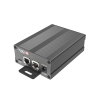
A weather monitoring station is only as good as its enclosure: the housing must keep rain, dust, salt and condensation off the electronics while staying neutral enough not to distort readings. This guide covers IP rating selection for real U.S. climates, material trade-offs, internal layout for common sensor form factors, cable and power integration, and condensation control — with the YONGU MH03 IP65 split aluminum sensor enclosure as the working example.
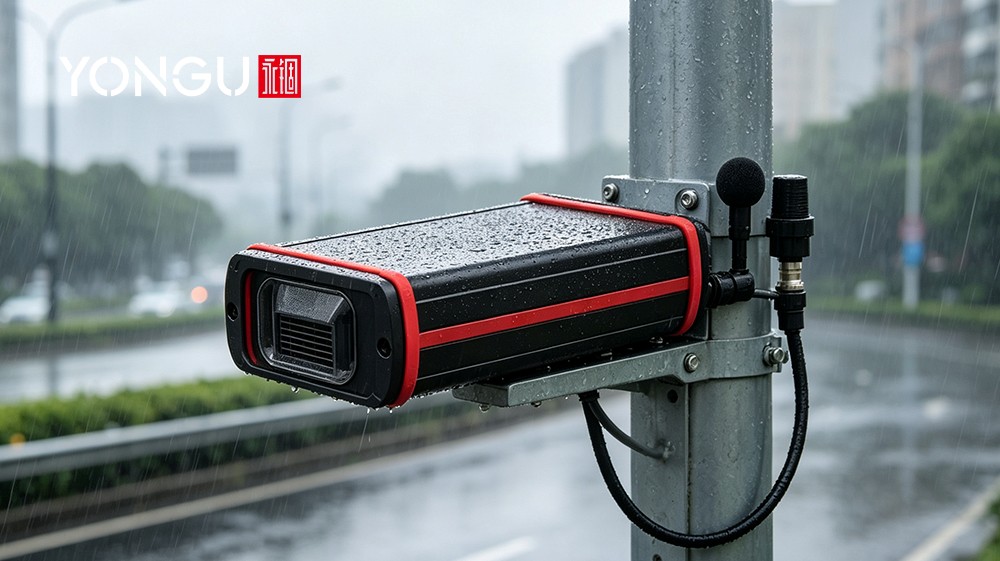
Ingress Protection and IP Rating Guidance
IP ratings describe test conditions, not marketing claims. An IP65 enclosure survives low-pressure water jets (6.3 mm nozzle, 12.5 L/min, 3 m); IP66 adds powerful jets (12.5 mm nozzle, 100 L/min); IP67 survives temporary immersion in 1 m of water for 30 minutes. For U.S. deployments, match the rating to exposure: coastal fog and salt spray, wet-season rain, snow and freeze-thaw, and dusty rural sites stress housings differently. The full IP54–IP68 rating guide and NEMA vs IP comparison map the ladder, from splash to immersion.
| U.S. deployment | Minimum rating | Why |
|---|---|---|
| Inland rural, dust and light rain | IP54–IP65 | Windblown dust and occasional showers; IP5X/6X dust protection is the main need |
| Southeast / Gulf heavy rain seasons | IP65–IP66 | Hour-long downpours and wind-driven water; jet tests mirror hose-down conditions |
| Coastal fog, salt spray, marine | IP66 + corrosion treatment | Salt-laden fog attacks seals and fasteners; pair the rating with anodized aluminum |
| Snowbelt, freeze-thaw cycles | IP65–IP66, sealed glands | Melting snow and ice push water into gaps; gaskets must stay elastic at -30°C |
| Flood-prone lowlands / creek sites | IP67 | Short-term submersion during flash floods; raise the box above known water levels |
Mounting height changes the exposure too: a pole-mounted logger box at 3 m sees less splash than a wall box at 0.5 m, but more wind-driven rain. When a vendor quotes only "IP65" without a test report, ask for the IEC 60529 certificate and seal material — the rating is meaningless without a traceable test. YONGU publishes its independent IP68 report on the downloads page.
Enclosure Materials and Durability
Material choice drives both survival and data quality. ABS is cheap and light but degrades under UV and offers little thermal help; polycarbonate resists impact and UV better, yet both plastics act as insulators and can trap heat around temperature sensors. Aluminum (6063-T5 extrusion) conducts heat well, holds anodized or powder-coated finishes for decades outdoors, and is roughly three times stiffer per unit weight than ABS at similar wall thickness. Stainless steel resists corrosion best but is heavy, expensive to machine, and its high thermal mass can lag ambient readings if mounted without a radiation shield.
For measurement accuracy, treat the enclosure as a thermal actor: a dark metal box in direct sun can run 10–15°C above ambient internally, which biases temperature and humidity sensors unless they are aspirated or radiation-shielded. Sensor-specific housings such as the MH03 IP65 split aluminum enclosure keep boards close to ambient while their split extruded body lets you drop in pre-assembled PCBs without rework. On the longevity side, anodized aluminum (Type II/Type III) and marine-grade powder coating typically outlast 10+ years of outdoor service, while untreated ABS shows chalk and micro-cracking within 3–5 years in high-UV states. Validate claims with standard aging tests: ASTM B117 salt spray for coastal exposure and ASTM G154 UV-condensation cycles; ask suppliers for their test data or run a 500-hour screening before committing a full station. YONGU offers anodizing color options and laser engraving on the MH series, and the coastal salt-spray guide details what to specify for shoreline installations.
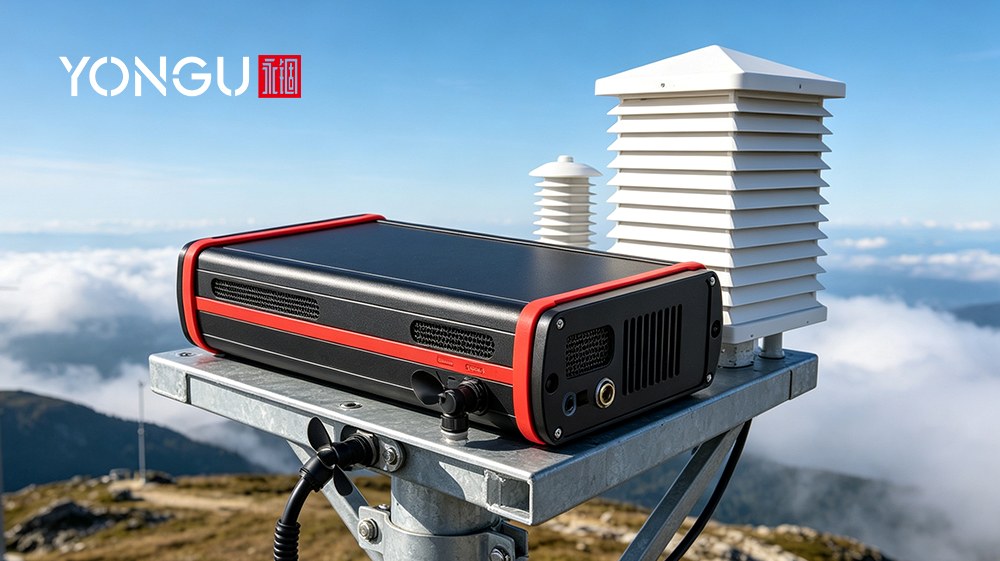
Internal Layout, Sizing, and Sensor Compatibility
A weather station enclosure needs a disciplined interior: a flat mounting base or threaded standoffs for the logger, a reserved grounding zone, clearance for connectors, and an isolated corner for the battery or solar charge controller so heat and leakage current never reach sensitive inputs. Layout rules that prevent field failures: keep the antenna and cellular module away from the sensor terminations; separate power wiring from signal wiring by at least 25 mm; and leave a thermal gap around temperature probes so they read air, not the enclosure wall.
| Sensor / subsystem | Typical footprint | Recommended housing range | Layout note |
|---|---|---|---|
| Datalogger / control board | 60–90 × 40–60 mm | 108 × 42 mm and up | Standoffs 6–10 mm keep board off the wall |
| Temp / humidity probe electronics | 40 × 30 mm or probe-only | Compact, ventilated zone | Probe through gland or side port, not touching wall |
| Pressure / air-quality sensors | 30–50 × 30–50 mm | 108 × 42 mm to 180 × 70 mm | Vented port for ambient reference, filter for PM |
| Cellular / radio module + antenna | 50 × 40 mm + antenna | Isolated end compartment | Antenna cable in separate gland, minimum bend radius respected |
| Battery / solar charge controller | Depends on capacity | Dedicated box or isolated corner | Vent heat, keep away from sensor zone |
For brand fit, do a 3D review: Campbell Scientific CR-series loggers, Vaisala HMP-series probes and Davis consoles are representative of the 40–90 mm board widths above, but every revision changes the footprint — request the STEP model and drop your actual board into it. YONGU supplies drawing formats including STEP, SOLIDWORKS, CAD, CDR, AI and PDF for exactly this check, plus hole-drilling customization so the MH03 or the MJ03 gateway box is cut for your exact connectors. See how to choose a sensor enclosure and the custom sensor housing guide for sizing walkthroughs.
Mounting, Cable Entry, and Power Integration
Mounting and cable entry fail more often than the enclosure itself. On poles and masts, use stainless U-bolts or clamps sized to the mast diameter with the box oriented so the gland side faces down and away from prevailing wind; on rooftops and walls, add a 20–30 mm standoff to let water and heat escape behind the housing. Fastener guidance: M4 stainless screws torqued to 1.5–2.0 N·m and M5 to 2.5–3.5 N·m for aluminum threads, using a torque driver, and re-torque after the first thermal cycle. Vibration on high masts loosens screws — apply thread-locker (medium strength) on outdoor fasteners and check quarterly.
Every cable is a potential leak. Match the gland to the cable: PG7 suits Ø4–6 mm cables, PG9 Ø6–8 mm, PG11 Ø8–10 mm, and 1/2" NPT is common for U.S. conduit runs; tighten gland nuts to 2–3 N·m and confirm the seal ring compresses around the jacket, not the braid. Use separate glands for signal and power, add a drip loop outside, and never share a gland with an antenna cable. The MH03's split body opens at both ends, so custom-drilled PG7/PG9/NPT ports land exactly where cables route.
Power integration follows the same discipline: keep the solar charge controller and battery in a separate, ventilated compartment or a dedicated IP68 battery case such as the M08 battery enclosure, and mount solar panels on a standoff so heat never conducts into the sensor zone. Ground the enclosure to the station's earth rod with a braided strap, and fit a surge protector at the panel input for lightning-prone regions; a grounded aluminum housing also gives a quiet reference plane for sensitive analog inputs. For full stations, YONGU's solar network enclosure and the wall-mount waterproof range cover panel-to-battery integration in one box.
Ventilation, Condensation Control, and Maintenance Design
A sealed box still breathes: as temperature swings, humid air is drawn in through microscopic gaps and condenses on the coolest surface. Practical rules: use a pressure-equalizing breather or hydrophobic membrane when the box is sealed and the station experiences large day-night swings; add a desiccant canister in humid climates and replace it when the indicator changes (typically every 6–12 months); and use a low-wattage enclosure heater or the natural heat of the electronics when dew point is reached inside. Fans are rarely needed in weather stations — they pull in dust and defeat the seal — so prefer passive strategies. The condensation prevention guide covers the membrane vs desiccant vs heater decision in detail.
Maintenance access decides long-term reliability: choose front-opening designs, captive or torque-limited screws, and quick-release latches where theft is a concern (roadside sites benefit from anti-tamper locks). Schedule quarterly seal and gland inspections after the first year, an annual re-torque of all fasteners, and a 6-monthly desiccant check in Gulf or coastal states. Document torque values and gland sizes — a one-page spec table prevents field crews from over-tightening aluminum threads. For humidity-critical installations, YONGU's temperature and humidity monitoring case study shows a production build with the same layout and sealing discipline.
Conversion
YONGU supports weather-station builders with an installation checklist, editable CAD/3D files (STEP, SOLIDWORKS, CAD, CDR, AI, PDF), a sensor compatibility matrix, and a torque and cable-gland specification table for the MH03 and every other waterproof series. Request a sample in the U.S. through the contact page or customize the housing directly: hole drilling, anodizing colors, laser engraving and silk screen are available with no minimum order quantity, and drawing review plus quotation typically turns around within 24–48 hours. Compliance documentation (ROHS, REACH, independent IP68 test report) ships with the RFQ, and UL/CE-related material and test information can be provided per program. Send your board footprint and mounting sketch — we will cut the housing to your sensors and hand you a station-ready box.
FAQs
What IP rating is recommended for outdoor weather monitoring stations in different U.S. climates?
IP54–IP65 for inland rural sites, IP65–IP66 for heavy-rain regions, IP66 plus anodized finish for coastal salt spray, IP65–IP66 for snowbelt freeze-thaw, and IP67 where flash flooding is possible. Always pair the rating with the actual IEC 60529 test report.
How do enclosure materials affect sensor accuracy and long-term durability?
Plastics insulate and can trap heat around sensors; dark metal boxes can run 10–15°C above ambient in direct sun. Use radiation shields or aspiration, keep probes off the wall, and choose anodized aluminum or powder coating for 10+ year outdoor life with ASTM B117/G154 validation.
How should I size an enclosure and verify compatibility with common weather sensor models?
Size from the largest board plus connector and battery clearance (typically 108 × 42 mm or larger), and do a 3D fit check: request the STEP model and drop your actual board into it. YONGU provides STEP/SOLIDWORKS/CAD drawings and custom hole drilling for exact fits.
What are the best practices for cable glands and preventing water ingress at feed-throughs?
Match gland to cable diameter (PG7 for Ø4–6 mm, PG9 for Ø6–8 mm, PG11 for Ø8–10 mm, or 1/2" NPT), tighten to 2–3 N·m, keep signal and power on separate glands, add drip loops, and orient glands downward.
Which strategies most effectively prevent condensation in humid or rapidly changing temperatures?
Pressure-equalizing breathers or hydrophobic membranes for sealed boxes, desiccant canisters replaced every 6–12 months, and low-wattage heating at dew point. Avoid fans, which pull dust through the seal.
Do remote weather stations require active thermal management or integrated solar and power solutions?
Rarely active cooling; passive strategies and isolation usually suffice. For solar-powered sites, keep the battery and charge controller in a ventilated or dedicated IP68 battery box, mount panels on standoffs, and ground the enclosure with surge protection.
What maintenance schedule should I follow for long-term reliability?
Quarterly seal and gland inspections and fastener checks after the first year, an annual re-torque, and 6-monthly desiccant replacement in humid states. Document torque values and gland sizes so field crews cannot over-tighten aluminum threads.