An IP67 outdoor enclosure is dust-tight and survives a 30-minute dunking at one meter — but the rating alone does not make a box weatherproof in service. What decides field reliability is the alloy, the coating, the gasket's behavior through UV and thermal cycling, and whether the cable entries are sealed as carefully as the lid. This guide covers the outdoor-specific decisions behind a working IP67 aluminum enclosure: what the rating really proves, why aluminum outperforms plastic outdoors, how temperature and UV age the seal, and how to specify glands, mounting, and finish so the box still passes IP67 after three summers on a pole.

IP67 Rating for Outdoor Applications
IP67 comes from IEC 60529: the first digit 6 means dust-tight (no ingress of dust at all), the second digit 7 means protection against temporary immersion — defined test conditions of 1 meter depth for 30 minutes, with no harmful ingress. For outdoor electronics that is the practical baseline for pedestal boxes, sensor housings, pole-mounted controllers, and irrigation or lighting drivers exposed to rain, snow melt, hose spray from maintenance, and short-term flooding at the base of an installation. It sits between IP66 (powerful jet spray, but not immersion) and IP68 (continuous submersion at a depth agreed between manufacturer and user). Choosing IP67 rather than IP68 is usually a cost decision: IP68 demands a heavier seal and often a cast or welded housing, while IP67 suits extruded aluminum with a compressed gasket.
What IP67 Protects Against (and Doesn't)
IP67 proves two things only: dust cannot enter, and a 30-minute, one-meter immersion does not let water in under test conditions. It does not prove resistance to a high-pressure, high-temperature washdown jet — that is IP66/IP69K territory — and it does not cover prolonged submersion, which requires IP68 with a declared depth and duration. More important for outdoor service, IP67 says nothing about condensation: a sealed box that heats by day and cools at night breathes through its gasket and accumulates moisture inside, which is why outdoor IP67 designs add a breather membrane or desiccant — see preventing condensation in outdoor enclosures. Nor does IP67 imply corrosion resistance — an uncoated aluminum box can be perfectly watertight and still pit at a scratched edge in salt air. And the rating applies to a properly assembled enclosure: an open cable entry, a gland installed without its sealing washer, or a lid torqued unevenly voids the protection regardless of the label.
Aluminum vs Plastic for Outdoor IP67
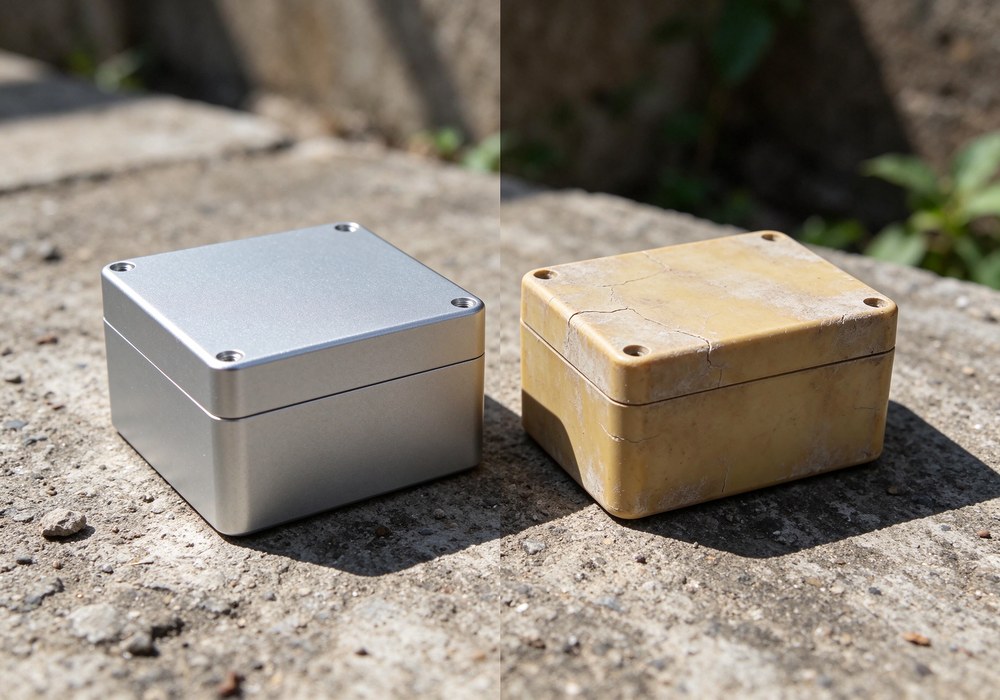
Both materials can carry an IP67 label; they age very differently outdoors. Aluminum brings structural rigidity, dimensional stability, effective heat spreading for sealed electronics, and a naturally UV-stable surface — anodizing adds corrosion resistance without any organic coating to chalk or peel. Plastics are lighter and cheaper in small sizes, but ABS embrittles and yellows under UV unless stabilized, polycarbonate holds impact better yet still needs UV stabilizers, and both expand roughly two to three times more than aluminum per degree, which works against gasket compression through thermal cycling. Plastics also cannot spread heat or provide EMI shielding. The trade-off table below summarizes the outdoor decision.
| Criterion | Anodized aluminum | ABS / polycarbonate |
| UV stability | Inherent; oxide does not degrade | Requires UV stabilizers; ABS yellows, embrittles |
| Thermal expansion | ≈ 23 µm/m·K (6063) | ≈ 50–70 µm/m·K |
| Heat dissipation | Good; acts as a heat spreader | Poor; hot spots inside sealed box |
| Impact / rigidity | High stiffness; dents rather than cracks | PC good impact, lower stiffness; ABS cracks |
| EMI shielding | Inherent when bonded/grounded | None without conductive coating |
Outdoor Environmental Challenges
UV & Temperature Extremes
Sunlight and thermal cycling attack the seal, not the metal. UV exposure is evaluated with fluorescent UV apparatus per ASTM G154-23; a year outdoors can equal several hundred hours of accelerated UV, and the first thing to degrade on a plastic box is the surface, while on any box it is the gasket. Silicone gaskets hold from roughly −60 °C to +200 °C and stay flexible; EPDM is cheaper and UV-resistant but takes a permanent set after long compression; neoprene hardens. Temperature cycling — specified in IEC 60068-2-14:2023 — is the real killer: a sealed box at −20 °C in winter and +70 °C in summer sun moves its lid and gasket by differential expansion, and the internal air pressure change pumps moisture past a marginal seal. Design responses: specify gasket compression around 20–30%, use a groove rather than a flat face, keep the flange wide enough that thermal movement cannot lift the seal, and add a breather membrane to equalize pressure without admitting liquid water.
Vibration & Impact
Pole-mounted and trailer-mounted enclosures see wind-induced vibration and handling impacts. Sine vibration testing to IEC 60068-2-6 and impact ratings (IK codes per IEC 62262) give a language for specifying this, but the practical fixes are structural: mount the box on a bracket with a standoff so wind load transfers to the pole rather than the lid, use thread-locking or nyloc fasteners on the gland and bracket bolts, and avoid long unsupported aluminum panels that can drum in gusty conditions. For enclosures on vehicles or portable masts, add a rubber isolation pad under the mounting feet and specify a minimum wall thickness rather than relying on the gasket to hold the assembly rigid.
Cable Gland Sealing for Outdoor
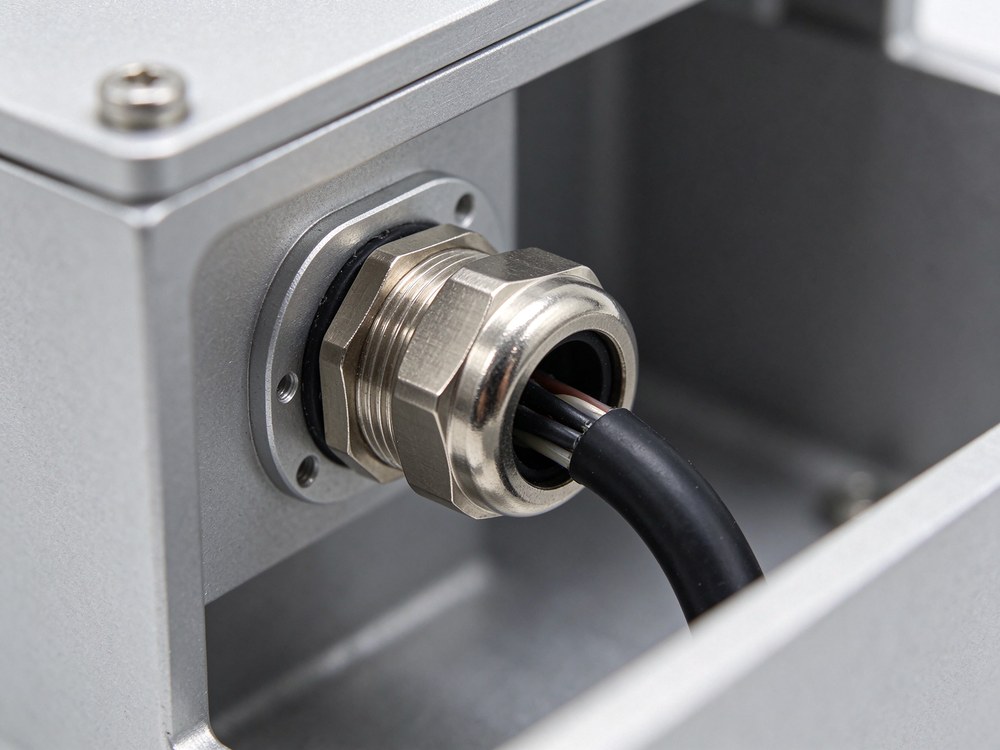
Most outdoor IP67 failures trace to cable entries, not the lid. Each gland must match the cable's outer diameter: an M12 gland typically covers roughly 3–6.5 mm, M16 about 4–8 mm, M20 about 6–12 mm, and M25 about 10–17 mm; a gland sized for a thinner cable cannot compress enough, and one sized for a thicker cable will not close at all. Install the sealing washer against the enclosure face, tighten to the manufacturer's torque (typically 2–5 N·m for nylon glands, higher for metal), and use a thread sealant on metal glands in coastal or washdown service. Multi-hole glands suit several small cables; unused holes must be closed with blind plugs, never left open to "breathe". Add a cable support or strain-relief loop inside so pulling on the cable does not lever the gland out of its seat — mechanical stress relief is as important as the seal itself.
Mounting Options for Outdoor
Where and how the box sits changes its real exposure. Wall mounting with a standoff spacer keeps the back face dry and lets condensation drain; a slight downward tilt plus a weep hole at the low corner prevents pooling on the lid. Pole mounting uses stainless or galvanized brackets with two-point clamping so the box cannot rotate in wind; roof and parapet installations benefit from a sun shield that keeps direct radiation off the top face, cutting internal peak temperature by a meaningful margin. Keep the enclosure out of lawn-sprinkler and irrigation spray zones, and avoid mounting directly above paving where splash rebounds. For compact installations, wall-mounted waterproof enclosures for compact installations with a gasketed lid and sealed entries are the simplest way to keep the assembly at IP67; larger cabinets should specify anchor bolts sized for wind load and a service clearance for gasket inspection. Coastal sites should also plan for salt spray, covered in marine-grade enclosure salt-spray protection.
IP67 Aluminum Enclosure Selection
For outdoor IP67 duty, the standard YONGU answer is a 6063 extruded profile with a sealed anodized finish and a compression gasket. The IP67/IP68 waterproof aluminum profile enclosure (L06A, 150 × 115 mm) covers compact outdoor electronics and can be drilled for glands or connectors on request; the wall-mount waterproof box range and wall-mount aluminum enclosures handle larger wall and bracket installations. Sensor nodes fit the MH03 sensor enclosure (108 × 42 mm). Specify anodize thickness for coastal sites, stainless or plated fasteners, and a breather membrane where temperature swings are wide; IP68 test reports and material certificates are available for design review. For rating comparisons before you commit, see IP65 vs IP67 for outdoor electronics, IP65 vs IP68, and the waterproof enclosure guide.
Size the enclosure to the site, not to the catalog. Send YONGU the mounting location, cable count and diameter, ambient temperature range, and whether the box sees washdown or standing water — we will match an IP67 aluminum housing, specify gland sizes and gasket material, and confirm the finish for your climate. Samples ship in about 5–7 working days at MOQ one, with IP and salt-spray reports on request. Start through the contact page; test reports and drawings are on the downloads page.
FAQs
Is IP67 good enough for outdoor use?
For most outdoor electronics, yes — IP67 covers dust-tight sealing plus 30 minutes at one meter, which handles rain, snow melt, and short-term flooding. It does not cover continuous submersion (IP68) or high-pressure hot washdown (IP66/IP69K), so match the rating to the actual exposure.
What is the difference between IP66 and IP67 outdoors?
IP66 resists powerful water jets from any direction but is not rated for immersion; IP67 is dust-tight and survives 1 m for 30 minutes but is not tested against a directed high-pressure jet. For exposed coastal or washdown sites, some designs specify a housing that satisfies both duties.
Can a plastic IP67 box be used outdoors?
Yes, if the plastic is UV-stabilized and the gasket is suited to the temperature range. ABS without stabilizers yellows and embrittles within a few seasons; polycarbonate holds up better. Aluminum remains preferable where heat, rigidity, or EMI shielding matters.
Why does my IP67 enclosure leak after a year?
Usually the gasket or a cable entry, not the housing. UV and thermal cycling take a permanent set out of EPDM, an undersized gland cannot compress its seal, and an untorqued lid or missing sealing washer opens a path. Inspect gaskets annually and re-torque to specification.
Should I choose IP67 or IP68 for a buried or flooded installation?
IP68 — it is rated for continuous submersion at a depth agreed with the manufacturer. IP67's 30-minute, one-meter test does not represent standing water or a sump. For vaults and underground cable boxes, specify IP68 with the actual depth.
What temperature range can an outdoor IP67 aluminum enclosure handle?
The aluminum housing itself is fine from −40 °C to +85 °C; the limit is the gasket and the electronics. Silicone seals cover roughly −60 °C to +200 °C, EPDM about −40 °C to +120 °C, so match the seal to the site's extremes and derate internal electronics for solar gain.