The operational continuity of an automated manufacturing line fundamentally relies on housing sensitive programmable logic controllers (PLCs), variable frequency drives (VFDs), and relay networks within highly tailored, precision-fabricated metal infrastructure. Rather than forcing complex electrical layouts into restrictive, generic boxes, a customized sheet metal structure provides the exact volumetric geometry, thermal ventilation, and rigid mechanical defense required to prevent catastrophic downtime in volatile factory floor environments.
The Real Cost of Inadequate Panel Integration
For system integrators and automation engineers, designing the internal logic and safety circuits of a machine is only half the battle. The physical reality of the factory floor is brutal. Heavy stamping presses generate structural shockwaves, CNC milling centers aerosolize conductive coolant oils, and heavy industrial motors generate intense ambient heat.
When engineers attempt to utilize standard, off-the-shelf plastic or unmodified metal boxes, immediate operational pain points emerge. Standard dimensions often lead to compromised wire routing, creating overcrowded cable ducts where electromagnetic interference (EMI) jumps between high-voltage power lines and sensitive 24V DC sensor signals. Furthermore, VFDs and power supplies generate significant localized heat. If the enclosure lacks precisely engineered ventilation strategies, internal temperatures rapidly exceed component tolerances, resulting in erratic CPU resets, melted wire insulation, and eventual system failure. In a high-throughput factory where an hour of machine downtime can cost thousands of dollars, the enclosure is not a mere accessory—it is a critical line of defense.
Why Sheet Metal Bending is the Ultimate Solution for Panel Builders
The manufacturing process of sheet metal bending offers distinct architectural advantages over injection molding or deep extrusion, specifically aligned with the unpredictable demands of industrial automation.
First, it offers unparalleled spatial scalability without prohibitive tooling costs. If a machine design requires a sudden upgrade—such as adding three more servo drives or a larger uninterrupted power supply (UPS)—a sheet metal enclosure can be quickly resized in CAD software. The metal blanks are laser-cut and folded via CNC press brakes to accommodate the new depth or width instantly, avoiding the tens of thousands of dollars required to modify a die-cast mold.
Secondly, sheet metal provides immense structural rigidity while maintaining a relatively thin wall profile, maximizing the internal real estate available for DIN rails, wire management raceways, and grounding busbars.
Solving the "Manual Modification" Nightmare
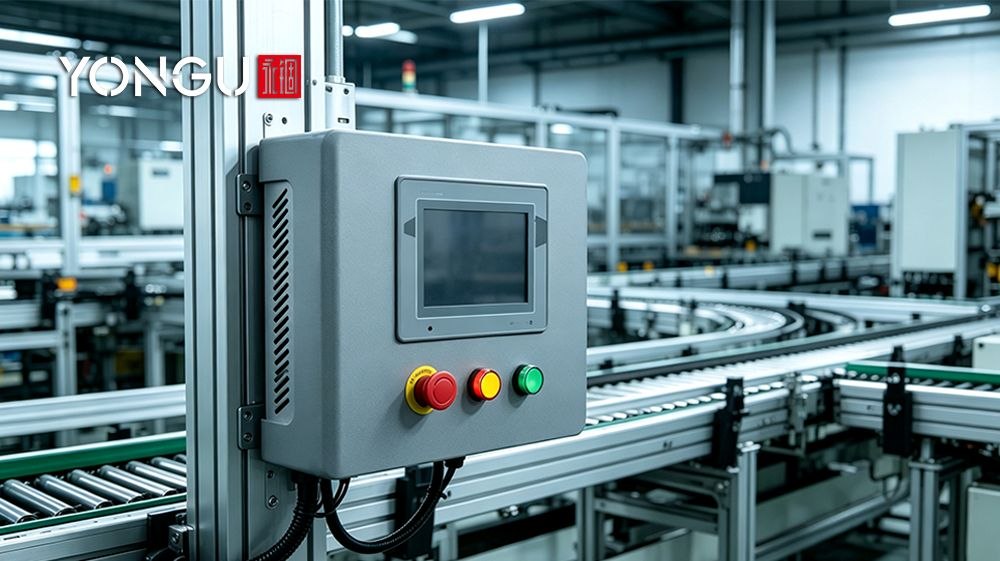
Perhaps the most frustrating and labor-intensive phase for control panel builders is the manual modification of standard boxes. Cutting square holes for Human Machine Interfaces (HMIs), drilling dozens of 22mm holes for push buttons and emergency stops, and using step bits for heavy-duty bottom cable glands is a chaotic process. It creates jagged edges, leaves conductive metal shavings that can short out PLCs, and routinely damages the anti-corrosion paint finish.
This is precisely where modular design and professional manufacturing capabilities intersect to streamline system integration. To eliminate modification bottlenecks, automation designers deploy precision-fabricated solutions like the highly versatile custom sheet metal control box systems engineered by YONGU.
Whether you are building a localized motor control center or a decentralized edge-computing node, relying on a dedicated factory automation enclosure—such as the YONGU E02 Series—dramatically accelerates your production line. Leveraging their advanced sheet metal fabrication facilities, YONGU provides fully custom laser cutting and CNC punching directly from your CAD files. Your industrial control panel box arrives with every HMI window, cooling louver, and button array perfectly machined and finished with heavy-duty powder coating or anodic oxidation. The enclosures are delivered globally, ready for immediate DIN rail installation and wiring, turning a days-long mechanical chore into a seamless plug-and-play assembly step.
Thermal Dynamics and EMI Mitigation in Sheet Metal
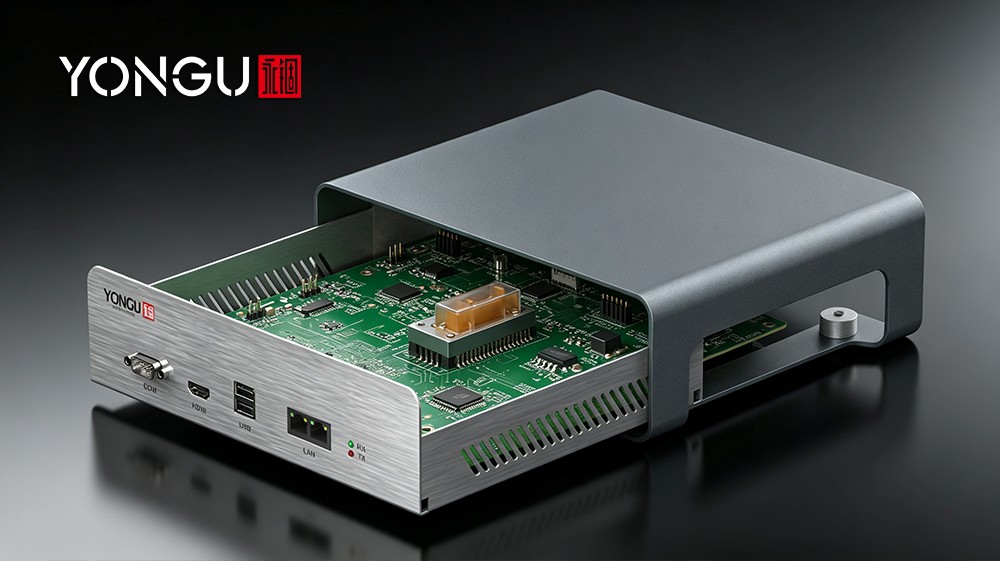
High-quality sheet metal enclosures excel in handling two of automation’s biggest invisible threats: heat and electromagnetic noise.
EMI Shielding: In automation, data flows constantly via industrial ethernet protocols (PROFINET, EtherCAT). Thick sheet metal (such as carbon steel or aluminum) inherently creates a Faraday cage, blocking high-frequency noise from adjacent factory equipment and protecting the integrity of your data packets.
Thermal Flexibility: Unlike sealed plastic boxes, custom sheet metal allows for intelligent thermal engineering. Engineers can specify custom louver patterns near the bottom for cool air intake and automated exhaust fan cutouts at the top, perfectly aligning with the thermal output zones of the specific VFDs mounted inside.
Material and Process Comparison for Automation Housings
To assist system integrators and procurement teams in specifying the correct hardware for machine builds, the following matrix compares customized sheet metal against other common industrial enclosure manufacturing methods:
| Manufacturing Method | Upfront Tooling Cost | Dimensional Flexibility | HMI & I/O Customization Ease | Ideal Automation Scenario |
|---|---|---|---|---|
| Custom Sheet Metal (Laser/Bend) | Very Low (Program-based) | Unlimited (Easily scales HxWxD) | Exceptional (Factory laser cut) | Custom machinery, robotic cells, localized motor control panels. |
| Die-Cast Aluminum | Extremely High (Custom Molds) | Rigid (Locked to mold size) | Requires secondary CNC milling | High-volume standardized OEM edge-sensors in extreme impact zones. |
| Standard Polycarbonate (Plastic) | Zero (Off-the-shelf) | Rigid (Pre-defined sizes only) | Poor (Prone to cracking during cuts) | Corrosive chemical areas with low heat and simple PCB logic. |
| Off-the-shelf Steel Boxes | Zero | Rigid | Requires manual drilling/punching | Simple electrical junctions with no complex displays or buttons. |
Frequently Asked Questions (FAQ)
Q1: How are internal components like PLCs and contactors mounted inside a sheet metal box?
A: Custom sheet metal boxes are typically designed with internal mounting studs or a dedicated, removable galvanized backplate. Engineers mount DIN rails and wire ducts directly to this backplate outside the box, which is then securely bolted into the chassis, drastically simplifying the wiring process.
Q2: Can sheet metal enclosures provide adequate grounding for industrial safety?
A: Yes. A critical advantage of metal enclosures is electrical safety. Custom boxes feature pre-welded grounding studs on the main chassis and the door, allowing for a continuous equipotential bonding circuit that safely directs fault currents to the ground, complying with UL and IEC standards.
Q3: Does custom sheet metal fabrication slow down project lead times?
A: Modern CNC laser cutters and automated press brakes have eliminated traditional lead-time delays. Partnering with a specialized manufacturer allows for rapid prototyping within days, as modifications only require an update to the CAD file rather than the fabrication of new physical molds.
Empower Your Automation Projects with Precision Housing
Do not allow standard boxes to dictate the layout of your critical automation infrastructure. Ensure thermal stability, spatial efficiency, and seamless component integration with high-quality sheet metal enclosures fabricated exactly to your blueprints.