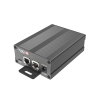
Your front panel carries the connectors, display, switches and brand identity of your product — and it is usually the first part a customer touches. Choosing between a plastic front panel and an aluminum front panel affects not only looks and cost, but also EMI shielding, heat dissipation, mechanical stiffness, weather resistance and recyclability. This guide compares the two materials with quantitative data you can actually design with, adds the installation details most suppliers skip, and shows real hybrid solutions — such as the YONGU Aluminum Plastic Panel Electrical Box K23C 200*55mm, an aluminum body with aluminum end panels plus plastic fixed panels — that let you combine the strengths of both materials in one enclosure.

Quick Side-by-Side Comparison and Decision Checklist
Before digging into the engineering, here is the 30-second comparison across the seven criteria that decide most front-panel material selections.
| Criterion | Aluminum Front Panel | Plastic Front Panel (ABS / PC / PBT) |
|---|---|---|
| Mechanical rigidity | High — 1.5–2 mm flat panel resists flex; E ≈ 69 GPa | Lower — needs 3–6 mm thickness or molded ribs; E ≈ 2.0–2.6 GPa |
| EMI / RFI shielding | Excellent — 60–90+ dB attenuation with continuous grounding | Negligible uncoated (<5 dB); 40–80 dB only after conductive coating or plating |
| Thermal conductivity | 138–201 W/m·K — panel can act as a passive heatsink | 0.17–0.27 W/m·K — thermal insulator |
| Weight | ≈ 2.70 g/cm³ | ≈ 1.0–1.4 g/cm³ — 40–60% lighter |
| Surface finish | Anodizing, powder coating, brushing — hard and scratch-resistant | UV printing, laser engraving, silk screen — color-rich but softer |
| Weather / UV durability | Excellent — anodized panels pass 336+ h salt spray | Good only with UV-stabilized grades; color can fade in direct sun |
| Recyclability | Infinitely recyclable, high scrap value | Limited — usually downcycled |
| Typical cost per part | $3–10 at 1,000 pcs (CNC / extrusion + finish) | $1–5 at 1,000 pcs (injection molded) |
| Tooling investment | Low — $800–2,500 extrusion die; CNC needs no tooling | High — $3,000–30,000 injection mold |
Quantitative Property Table (typical values for engineering reference)
The qualitative table above hides the numbers competitors rarely publish. The table below lists the properties that actually drive stiffness, shielding, heat and tolerance calculations for the two common aluminum alloys (6061, 5052), the extrusion alloy used in most YONGU enclosures (6063-T5), and the three common panel plastics (ABS, PC, PBT).
| Property (typical) | AL6061-T6 | AL5052-H32 | AL6063-T5 | ABS | PC | PBT |
|---|---|---|---|---|---|---|
| Density (g/cm³) | 2.70 | 2.68 | 2.70 | 1.04–1.07 | 1.19–1.20 | 1.30–1.38 |
| Young's modulus (GPa) | 68.9 | 70.3 | 68.3 | 2.0–2.3 | 2.2–2.4 | 2.3–2.6 |
| Tensile yield strength (MPa) | 276 | 193 | 145 | — | — | — |
| Tensile strength (MPa) | 310 | 228 | 205 | 30–45 | 55–70 | 50–60 |
| Thermal conductivity (W/m·K) | 167 | 138 | 201 | 0.17–0.25 | 0.19–0.22 | 0.20–0.27 |
| Coefficient of thermal expansion (µm/m·°C) | 23.6 | 23.8 | 23.4 | 73–108 | 65–70 | 60–90 |
| Surface resistivity | ≈0.03 Ω/sq (bare)* | ≈0.03 Ω/sq (bare)* | ≈0.03 Ω/sq (bare)* | 10¹³–10¹⁶ Ω/sq | 10¹³–10¹⁶ Ω/sq | 10¹³–10¹⁶ Ω/sq |
*Anodizing is electrically insulating (>10⁹ Ω/sq) — mask the anodized layer at grounding points or use a conductive conversion coating such as Alodine when EMI bonding is required. Values are typical published figures; always confirm with the material supplier for your specific grade and thickness.
Decision Checklist by Use Case
• Portable battery-powered device: choose a plastic panel when weight, electrical insulation and low cost dominate and the radio module is not co-located behind the panel. If the product carries a transmitter (BT/Wi-Fi/cellular), check radiated emissions first — see the EMI section below.
• Outdoor NEMA-rated enclosure: choose an anodized aluminum panel. It provides the corrosion resistance, UV stability and mechanical strength expected in NEMA 4 / 4X style outdoor enclosures, and it doubles as a heatsink for electronics in direct sun.
• High-volume production with strict EMI requirements (FCC Part 15 / CE EMC): choose aluminum. A continuous metal panel with bonded grounding is the lowest-risk, lowest-cost way to pass radiated-emissions testing — plastic would require an added conductive-coating step with its own process control.
• Rule-of-thumb thresholds: prefer aluminum when the panel must dissipate roughly 1 W/cm² or more of heat, or when you need >40 dB shielding without add-on treatments. Prefer plastic when the panel is purely cosmetic, weight-limited, and carries no heat or shielding load.
For a broader material comparison (metal vs plastic enclosure bodies), see our guide on electronics enclosure box materials.
Mechanical Performance: Strength, Rigidity, Impact Resistance, and Mounting
Mechanical rigidity is where aluminum and plastic diverge most sharply. Because the bending stiffness of a flat panel scales with E × t³ (modulus times thickness cubed), the 30× modulus gap between aluminum (~69 GPa) and ABS/PC (~2–2.6 GPa) means a plastic panel must be roughly 3.1–3.2× thicker to match the flex resistance of an aluminum panel of the same geometry.
• A 2.0 mm aluminum panel ≈ 6.4 mm ABS or 6.1 mm PC in bending stiffness — which is why practical plastic panels are 3–6 mm thick or use molded ribs, while aluminum panels are typically 1.5–3 mm.
• In tension, 6061-T6 (310 MPa) is ~7× stronger than ABS (30–45 MPa); 5052-H32 (228 MPa) is still ~5× stronger. Plastic panels are stiffness-limited, not strength-limited, in most front-panel applications.
• Aluminum yields and stays bent under extreme overload; plastics tend to crack or creep. For drop-prone portable instruments, the hybrid approach — aluminum body with shock-absorbing plastic end caps — is proven: the K23C enclosure is marketed precisely for its anti-collision and dust-proof panels on a rigid aluminum body.
Mounting Heavy Connectors and Cutout Reinforcement
Heavy connectors (D-Sub, USB-C with strain relief, mains inlets, RF bulkheads) and large cutouts are where front panels fail in the field. The rules below apply whether your panel is aluminum or plastic:
• Threaded holes in thin aluminum (<2 mm): use PEM-style self-clinching inserts or HeliCoil thread inserts instead of tapping directly — they carry repeated assembly cycles without stripping. In panels ≥2 mm, a standard tapped M3 hole is acceptable for light loads.
• Threaded holes in plastic: never tap directly into ABS/PC for load-bearing connectors. Use heat-set or ultrasonic brass inserts (typical insertion 250–300 °C heat-press) rated for pull-out; an M3 brass insert in ABS/PC typically holds 30–60 kgf pull-out. For single-assembly products, self-tapping screws into molded bosses can work if the boss has a supporting rib.
• Rib placement: put ribs directly behind connector mounting holes and along cutout edges on plastic panels — they redirect bending stress away from the cutout corners, where cracks start.
• Support pads / standoffs: mount heavy connectors on a metal support bracket or standoff pad that transfers load to the enclosure body, not just to the panel skin. This is standard practice on the YONGU K09 152*44mm and other K-series designs with aluminum end plates where connector loads are carried by the plate itself.

• Anti-vibration torque ranges: for M3 fasteners — 0.5–0.8 N·m into aluminum (or PEM insert), 0.4–0.6 N·m into a heat-set insert in plastic. For M2.5, reduce to 0.2–0.3 N·m. Add a medium-strength thread-locker (e.g., Loctite 243) and star washers on panels exposed to vibration. Retorque after 24 h: plastics relax under sustained clamp load.
Impact (IK) Ratings, Creep, and Inspection
• IK ratings: IK07 = 2 J, IK08 = 5 J, IK10 = 20 J impact energy. A 1.5–2 mm aluminum panel with edge support achieves IK08 without special features; plastic needs ribbed construction and a UV-stable grade (e.g., PC) to reach IK08–IK10. For handheld instruments the K-series anti-collision panels are a practical model to follow.
• Creep: ABS and PC creep (permanently deform) under sustained load, and the rate accelerates above 60 °C. Never use plastic panels as long-term clamping surfaces for heavy components without metal inserts or oversize washers. Aluminum creep is negligible at room temperature and only becomes a factor in sustained service above ~150 °C.
• Verification methods: for panels, run a pull-out test on inserts (record kgf), a drop/IK impact test on the assembled unit, and a torque-to-fail test on the highest-stress screw. Check hardness (e.g., Rockwell) on anodized aluminum for finish quality control. YONGU's factory holds CNC tolerance ≈ ±0.05 mm and laser cutting ≈ ±0.1 mm, so cutout and mounting-hole positions are repeatable part to part.
EMI/RFI Shielding and Grounding Strategies for Metal and Plastic Front Panels
If your product must pass FCC Part 15 or CE EMC radiated-emissions testing, the front panel is usually the largest aperture in the enclosure — and the material choice decides how much engineering you will spend on it.
Aluminum Front Panels: Natural Shielding + Grounding Paths
A bare aluminum panel with continuous electrical contact to the enclosure body provides roughly 60–90+ dB of shielding up to 1 GHz. The engineering work is not the metal — it is the seam:
• Panel-to-body contact: keep the mating flanges bare (mask the anodizing at contact points) or specify a conductive conversion coating such as Alodine. YONGU offers an Alodine option and can also make anodizing non-conductive when electrical insulation is the goal — state which you need at inquiry time. See our aluminum conductivity tips for the full list of options.
• Conductive gaskets: use knitted wire mesh or conductive-elastomer gaskets in the flange groove. Compress them 15–25%; the gasket must make metal-to-metal contact on both sides. Fastener spacing of ≤ λ/20 at the highest frequency of concern (≈15 mm at 1 GHz, ≈150 mm at 100 MHz) keeps the seam tight.
• Screw bonding: star washers that bite through oxide layers and a dedicated grounding screw from panel to chassis are cheap insurance. Target a grounding impedance ≤ 10 mΩ between panel and body.
Plastic Front Panels: How to Add Shielding (the Part Most Guides Skip)
Uncoated plastic provides <5 dB shielding — effectively none. But plastic panels can be made conductive with several processes, in increasing order of performance:
• Conductive paint (Ni/Cu acrylic): 40–70 dB at 2–3 mil (50–75 µm) film. Cost-effective, maskable to keep cosmetic surfaces clean. Surface resistance target ≤ 1 Ω/sq.
• Electroless nickel/copper plating: 60–80 dB, more durable and corrosion-resistant than paint. Best for high-volume production.
• Conductive film / foil (Cu or Al adhesive tape): 60–80 dB when applied with overlap at seams; a good prototyping and low-volume option.
• Printed conductive ink (silver or carbon): 30–50 dB; useful for selective shielding of specific areas rather than the whole panel.
• Adhesive shielding foil + braided gasket: combine a foil with a conductive fabric/braid gasket around the panel edge to close the seam to the body — this is the practical way to make a plastic panel pass EMC without full metallization.
Testing, Measurement, and FCC/EMC Pitfalls
• Surface resistance: four-point probe, target ≤ 1 Ω/sq for coatings, ≤ 0.1 Ω/sq for plated surfaces.
• Grounding impedance: measure panel-to-body bond with a micro-ohmmeter, target ≤ 10 mΩ.
• Shielding effectiveness: SE (dB) = 20·log(E₀/E₁); test planar samples per ASTM D4935 or the assembled box per MIL-STD-285 / IEEE 299.
• Common pitfalls: (1) anodized aluminum panels are insulating — masking the anodize or adding a gasket is mandatory, not optional; (2) grounding the panel at only one point can turn it into an antenna at some frequencies — bond at multiple points or continuously; (3) galvanic corrosion between the gasket and dissimilar metals (e.g., copper gasket on aluminum) — pick compatible materials; (4) on plastic panels, coating the inside is not enough — the seam to the metal body must be closed with a conductive gasket or foil.
For the full workflow, read what EMI shielding is and which enclosure to use, the three critical EMI enclosure design principles, and our EMC & EMI testing guide.
Thermal Management: Conductivity, Heat Sinking, and Thermal Expansion
Thermal conductivity is the single biggest physical difference between the two materials — a factor of roughly 600–1,000×. Aluminum conducts 138–201 W/m·K (6063-T5 is the best at ~201); ABS, PC and PBT conduct only 0.17–0.27 W/m·K. Specific heat is comparable per kilogram (aluminum ≈ 900 J/kg·K; ABS ≈ 1,400; PC ≈ 1,200; PBT ≈ 1,200), but because aluminum is 2–2.6× denser, a metal panel stores and spreads roughly twice the heat per unit volume and moves it to the enclosure walls far faster.
When Can the Front Panel Be a Passive Heatsink?
• An aluminum panel of 1.5–3 mm, bonded to the enclosure body, can sink 5–10 W of heat over a typical 200×50 mm panel with natural convection — enough for many instrument, gateway and controller designs. The thermal conductivity of aluminum enclosures is why YONGU's extruded bodies double as heat spreaders.
• A plastic panel cannot spread heat at all. If you must keep plastic, add a metal insert (aluminum plate bonded behind the hot component) or a thermal pad / TIM that conducts from the component to a metal bracket or to the aluminum enclosure body. Thermally conductive plastics exist (~1–5 W/m·K) but cost more and still run 40× below aluminum.
• TIM rules: use a gap pad or phase-change material between the heat source and the metal path; keep the stack short — every interface adds resistance. Fastener preload maintains TIM compression; use spring washers so clamp force survives thermal cycling.
Thermal Expansion, Tolerance Design, and US Climate Reliability
• CTE mismatch: aluminum expands 23.4–23.8 µm/m·°C; ABS up to 108, PC 65–70, PBT 60–90. Over a 70 °C swing, a 200 mm aluminum panel grows ≈0.33 mm, while an ABS panel grows ≈1.26 mm — 3–4× more. Design cutouts and mounting holes accordingly.
• Hole / opening tolerance: for large panels (≥150 mm span) under wide temperature swings, give connectors and displays 0.5–1.5 mm of clearance or use slot-shaped holes so the panel can expand without stressing the component. Sliding fits plus a gasket absorb expansion; never rigidly clamp a large plastic panel at four corners and expect the cutouts to stay aligned.
• Fastener preload & cycling: plastics relax under sustained clamp load, and the relaxation accelerates with temperature. Retorque after the first 24 h, use Belleville or spring washers, and expect to re-torque after thermal-shock qualification.
• US environment reliability: in summer sun, dark anodized aluminum panels can reach 70–85 °C surface temperature; in cold storage or trucking, electronics see −40 °C. Qualify panels for at least 500–1,000 thermal cycles (−40 °C to +85 °C) if the product ships across US regions. Anodized aluminum is dimensionally stable across this range; plastics need UV-stabilized, low-absorption grades (PC or PBT over standard ABS) to avoid warpage and yellowing. See our guide on indoor vs outdoor enclosures for the full reliability checklist.
Manufacturing, Finishes, Cost, Lead Times, and Environmental Durability
Cost and lead time usually decide the material as much as physics does. The ranges below are typical US-market figures (indicative only — quote with your supplier); YONGU's own terms are listed at the end.
| Scenario | Plastic Front Panel | Aluminum Front Panel |
|---|---|---|
| Prototype — 10 pcs (3D print / CNC) | $15–80/pc, 1–2 weeks (US local) | $15–60/pc, 3–7 days (CNC from plate) |
| Prototype — 10 pcs (CNC machined from stock) | $30–100/pc | $15–60/pc |
| Production — 1,000 pcs | Mold $3,000–30,000 + $1–5/pc | Extrusion die $800–2,500 + $3–10/pc (CNC) |
| Production lead time | 4–8 weeks (mold making included) | 2–4 weeks |
YONGU (8+ years of aluminum enclosure export experience, serving 200+ countries and regions) offers samples in 5–7 days and batch production in 15–20 days, with MOQ = 1 pc — which removes the tooling-risk penalty of aluminum for low volumes. See the advantages of rapid-prototype enclosures for how to validate before committing to tooling.
Finishes: Anodizing / Powder Coating vs UV Print / Laser / Silk Screen
| Finish | Durability | Scratch resistance | Marking precision |
|---|---|---|---|
| Aluminum anodizing (Type II) | Excellent — 336+ h salt spray, UV-stable, 18–25 µm oxide | High (200–400 HV surface) | High — masked or laser-marked, ±0.1 mm |
| Aluminum powder coating | Tough 60–120 µm film, good impact | High | Medium — laser after coating |
| Plastic UV printing | Color-rich; needs clear coat for outdoor | Medium | Very high (600+ dpi inkjet) |
| Plastic laser engraving | Permanent, high contrast | High | Very high (±0.05 mm) |
| Plastic silk screen | Good — 3–5 yr outdoor with durable inks | Medium-high | High |
YONGU runs in-house anodizing (up to 9 colors, non-conductive option) plus laser engraving and silk-screen printing on the same production line — see how to choose the best anodized aluminum enclosure for the finish-selection checklist.
Long-Term Weathering, Recycling, and Compliance
• UV aging: standard ABS fades and yellows within 1–3 years of direct sun; PC resists better (with a UV coating it can last 5–10 years); PBT offers good UV and excellent chemical resistance. Anodized aluminum shows no UV degradation — the only concern is dye fading on decorative colors over many years outdoors.
• Chemical / salt exposure: anodized aluminum passes 336–1,000 h salt spray (marine-grade practice — see our marine salt-spray design guide); plastics are inherently salt-immune but degrade via UV and solvent attack. PBT/PC resist oils and many solvents better than ABS.
• Recycling: aluminum is infinitely recyclable with ~95% energy savings vs primary metal and a real scrap value — a genuine end-of-life advantage for US EPR (extended producer responsibility) trends. Plastics are typically downcycled into lower-grade products; recyclability varies by grade and local streams.
• Compliance: for panels sold into the US/EU, confirm RoHS and REACH (233 substances) declarations, and for plastic panels a UL 94 V-0/V-2 flame rating where the product is regulated — see our flame-rating guide for plastic enclosures. YONGU provides downloadable ROHS and REACH certifications plus an IP68 test report on the downloads page.
• US supply chain: for urgent US orders, local CNC shops can deliver machined aluminum panels in days and quick-turn anodizing/powder-coating services in 3–5 days; injection molding needs 4–8 weeks for tooling. For volumes from 1 pc upward, YONGU's in-house chain (design → molds → extrusion/die-cast → CNC → anodizing → printing) keeps both cost and lead time predictable, and the custom CNC machined enclosure line is the fastest route to a production-quality panel.
Conversion
Front-panel material selection is a trade-off between physics, cost and schedule — and the right answer depends on your specific cutouts, heat load and emissions targets. Send us your application points or CAD file and we will recommend the material, thickness, finish and mounting method for your enclosure, with a firm quotation. To get the fastest, most accurate proposal, include: (1) the use case and operating environment (indoor/outdoor, temperature range); (2) overall dimensions and panel thickness preference; (3) expected annual volume (prototype vs 1,000+ pcs); (4) your main interface, heat-dissipation and EMI requirements, including any connectors that need reinforcement. Our engineering team typically responds within 24 hours with a design review, and we can ship process samples (anodized or printed panels) for your evaluation together with the supporting ROHS, REACH and IP68 test reports. YONGU has 20+ years of aluminum enclosure experience with shipments to 200+ countries and regions — contact us or email [email protected] to start your project, or browse the K series aluminum-plastic hybrid enclosures and the full aluminum electronics enclosure range while you prepare your files.
FAQ
Which material provides better EMI shielding for an electronic enclosure front panel?
Aluminum, by a wide margin: a bare aluminum panel with continuous grounding provides 60–90+ dB attenuation up to 1 GHz, while uncoated plastic provides less than 5 dB. Plastic panels can reach 40–80 dB with conductive paint, electroless plating, conductive film or printed conductive ink — but the added coating step and seam treatment make aluminum the lower-risk choice for FCC/CE compliance. See the EMI section above and our EMI shielding enclosure guide.
How thick should an aluminum front panel be compared to a plastic one to achieve similar stiffness?
About 3.1–3.2× thicker. Because bending stiffness scales with modulus × thickness³, a 2.0 mm aluminum panel matches roughly a 6.4 mm ABS panel or 6.1 mm PC panel. Practical values are 1.5–3 mm for aluminum and 3–6 mm (or ribbed) for plastic.
What are the best methods to mount heavy connectors on plastic front panels without cracking over time?
Use heat-set or ultrasonic brass inserts for load-bearing threaded holes (M3 inserts in ABS/PC typically hold 30–60 kgf pull-out), place reinforcing ribs behind mounting holes and cutout corners, transfer heavy loads to a metal bracket or the enclosure body via support pads/standoffs, keep torque at 0.4–0.6 N·m for M3, and retorque after 24 h because plastics relax under sustained load. Avoid tapping directly into the plastic.
Can plastic front panels be treated to accept high-quality prints, anodize-like finishes, or conductive coatings?
Yes. UV printing, laser engraving and silk-screen printing all mark plastic panels with high precision. An anodize-like appearance can be simulated with metallic-pigment painting or metalized film (real anodizing is only for aluminum). For conductivity, plastic accepts Ni/Cu conductive paint (≤1 Ω/sq), electroless nickel/copper plating, adhesive foil, and printed conductive ink — each with a different shielding-effectiveness range (30–80 dB).
What are typical unit cost and lead time ranges for prototypes versus production quantities for plastic and aluminum panels in the U.S.?
Indicative US ranges: plastic prototypes $15–100/pc in 1–2 weeks; aluminum CNC prototypes $15–60/pc in 3–7 days. At 1,000 pcs, plastic injection molding costs $3,000–30,000 for the mold plus $1–5/pc (4–8 weeks); aluminum extrusion+CNC costs $800–2,500 for the die plus $3–10/pc (2–4 weeks). YONGU offers samples in 5–7 days and batch production in 15–20 days with MOQ of 1 pc.
How do aluminum and plastic front panels compare for outdoor durability, UV resistance, and end-of-life recyclability?
Anodized aluminum wins on all three: no UV degradation, 336+ h salt-spray capability, and infinite recyclability with ~95% energy savings. Plastics need UV-stabilized grades (PC or PBT over ABS) and can still fade in 1–3 years in direct sun; they are typically downcycled at end of life. For outdoor NEMA-style equipment, aluminum panels are the standard recommendation. See the NEMA vs IP rating guide and our full FAQ page for more.