Aluminum enclosures corrode when the conditions are right — salt air, moisture trapped behind a gasket, or a steel screw against an anodized panel. The good news: corrosion in aluminum is preventable, and the six methods in this guide cover every electronic enclosure scenario, from a coastal sensor box to a washdown control panel. Each method is backed by the test standards engineers actually cite — salt spray per ASTM B117-19, conversion coatings per ASTM B921-08(2023) — so you can specify protection that is measurable, not just claimed.

Why Aluminum Corrodes (and Why It Usually Doesn't)
Aluminum is electrochemically reactive, but it protects itself: in air it forms a dense oxide film (Al₂O₃, roughly 2–4 nm) within seconds, and that film is what stops further attack. In the neutral pH range of about 4–9, the oxide is stable, which is why aluminum doors, busbars, and enclosures last
decades indoors. Corrosion starts only when the film is breached or suppressed: chloride ions (salt) pit the oxide locally, a dissimilar metal creates a galvanic cell at a fastener, trapped water attacks under a coating edge, or an aggressive pH (below 4 or above 9) dissolves the film outright. So the practical question for an enclosure is not "will it corrode?" but "which failure mechanism will break the oxide first, and what stops it?" The six methods below each block a different path.

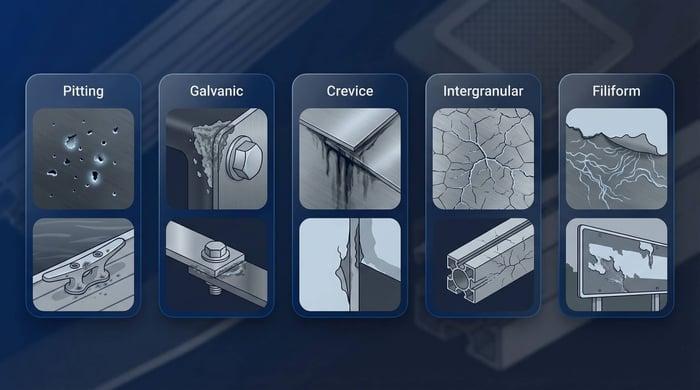
Common Corrosion Types in Aluminum
Galvanic Corrosion
Galvanic corrosion is the most common enclosure failure and the easiest to prevent. When aluminum touches a nobler metal — stainless steel, brass, copper — through an electrolyte such as salt water or condensation, the aluminum becomes the anode and corrodes at the contact point. The damage concentrates where the dissimilar metal is small relative to the aluminum area, exactly the geometry of a screw head against a panel. The fixes: use plated steel or zinc/aluminum fasteners instead of bare copper or brass; isolate stainless hardware with nylon washers and sealing compound; and never let dissimilar metals share a wet joint.
Typical salt-spray performance by protection method (ASTM B117, 5% NaCl at 35 °C, acceptance levels per MIL-A-8625 / MIL-DTL-5541 practice):
| Protection method | Typical B117 salt-spray result | Best for |
| Bare 6061 / 6063 | 48–96 h to first pitting | Indoor, dry environments |
| Sealed Type II anodize | 336 h+ before visible attack | Standard outdoor enclosures |
| Type III hard anodize | 336–1,000 h, high abrasion resistance | Coastal, handling, wear duty |
| Powder over conversion coating | 500–1,000 h before significant creep | Heavy outdoor, washdown, color-matched |
| Conversion coating only | 168–336 h (Class 1A practice) | Conductive base under paint |
Pitting Corrosion
Pitting is the classic salt-air failure: chloride ions penetrate weak spots in the oxide and drive localized dissolution, leaving small craters that can eventually perforate a thin wall. It is what salt spray testing (5% NaCl at 35 °C, per ASTM B117) accelerates. Bare 6061 or 6063 starts showing pits within roughly 48–96 hours in a B117 chamber; a sealed anodized coating typically reaches 336 hours or more before visible attack. In enclosures, pitting appears first at cut edges, drilled holes, and threads — the places where the coating is thinnest or was removed in machining.
Filiform Corrosion
Filiform corrosion is the thread-like trail that creeps under a powder coating or painted surface, most often on outdoor enclosures with poor pretreatment or humid climates. It starts at a coating defect or cut edge and spreads along the metal–coating interface as fine filaments. Filiform is a coating failure, not a metal failure: the cure is a conversion coating underneath the paint (chromate or non-chromate per ASTM B921), a clean surface before coating, and sealed edges.
Method 1: Anodizing
Anodizing is the workhorse corrosion protection for aluminum enclosures because it replaces the thin natural oxide with a controlled, thick one. Sulfuric-acid anodizing (Type II in the widely used MIL-A-8625 classification) grows a 5–25 µm oxide layer; hard anodizing (Type III) reaches 25–50 µm with much higher abrasion resistance. Sealing — hot water or nickel-acetate — closes the porous oxide and is what actually delivers salt-spray life: a sealed Type II coating commonly passes 336 hours in B117 before pitting, versus days for bare metal. Anodizing is also integrally colored or dyed, so the protection is the finish, not a coating on top of it. For outdoor electronic enclosures, specify Type II with sealing as the default, and Type III hard anodize where panels see handling, salt, or abrasion. The practical selection criteria are covered in how to choose an anodized aluminum enclosure, the anodizing process guide, and anodized enclosures in industrial settings. YONGU's custom-anodized chassis, such as the D08 anodized control chassis, show how the coating is applied across cutouts, card slots, and mounting bosses.
Method 2: Powder Coating
Powder coating gives aluminum a thick, tough barrier — typically 60–120 µm — that isolates the metal from moisture and chlorides entirely, provided the substrate is prepared correctly. The key is what happens before the powder: a conversion coating or etch primer underneath, because powder over bare aluminum can develop filiform corrosion at defects. With proper pretreatment, polyester or epoxy powder systems routinely run 500–1,000 hours in B117 salt spray before significant creep, which makes powder the right choice for heavy outdoor equipment, washdown housings, and color-matched industrial lines. Trade-offs against anodizing: powder hides machining marks better and adds color options, but it is a coating — chips and cut edges expose bare metal, so specify sealed edges and touch-up where holes are machined after coating. Surface treatment options and their durability are compared in custom enclosure finish treatments.
Method 3: Chromate Conversion Coating
Chromate conversion coating (chemical conversion film) is the thin, electrically conductive protection layer applied before painting or as a stand-alone finish — historically hexavalent chromium per MIL-DTL-5541 (Classes 1A and 3), and increasingly non-hexavalent chemistries qualified to ASTM B921 for RoHS- and REACH-driven projects. The film is only 0.5–1 µm, so it does not add dimension or abrasion resistance; its value is that it bonds tightly to the aluminum, blocks the galvanic and pitting paths at cut edges and threads, and stays electrically conductive — essential where the enclosure doubles as the EMI/grounding contact surface. Salt-spray life of a conversion film is modest by itself, which is why it is usually the foundation under powder or paint rather than the final finish. Specify chromate or ASTM B921-qualified conversion on every machined face, especially tapped holes and gasket flanges that anodize or powder cannot reach.
Method 4: Proper Gasket & Seal Design
Sealing stops the electrolyte, not the metal: if water and salt never reach the aluminum interface, none of the corrosion mechanisms above get their fuel. Design rules that matter on real enclosures: a continuous gasket groove with controlled compression (typically 15–30% on silicone or EPDM) so the seal does not pump water; a wide enough flange for the gasket to stay seated under fastener torque; drain provisions — a small weep hole at the lowest point — so any condensation that forms can escape instead of sitting against the metal; and sealed cable glands at every entry rather than bare punched holes. On outdoor boxes, also seal the fasteners themselves with captive O-rings or thread sealant, because a screw hole is a water path to the coating's weakest point. For a wall-mounted box this is exactly the IP66/IP67 engineering described in the IP68 outdoor guide — sealing and corrosion resistance go together.
Method 5: Material Alloy Selection
Alloy choice sets the ceiling for corrosion resistance before any coating is applied. 6061-T6 and 6063-T5 — the standard extruded enclosure alloys — offer good general corrosion resistance and take anodizing beautifully, which is why most YONGU housings use them. 5052 (and 5083) is the marine-grade choice: its magnesium content gives markedly better salt-water resistance, so it is preferred for coastal brackets, battery housings, and sheet-metal panels that will be painted rather than anodized. 7075 delivers the highest strength but the poorest corrosion resistance and must always be protected with a coating. Cast alloys such as ADC12/A380 are fine indoors but rely on the coating system outdoors, since cast skins can be porous. Rule of thumb: extruded 6063 or 6061 plus sealed anodize for most enclosures; 5052 sheet for marine and painted outdoor duty; and never use 7075 uncoated in a humid or coastal environment. The IP67/IP68 waterproof aluminum profile enclosure (L06A, 150 × 115 mm) is a standard example of 6063-class extrusion with anodized finish for outdoor service.
Method 6: Environmental Design
Enclosure placement and form factor decide how hard the protection has to work. Simple environmental moves reduce corrosion risk dramatically: mount with a downward tilt and weep holes so water drains rather than pools; keep vents and gaskets out of direct spray; add a rain shield or sun hood on exposed rooftops; leave clearance behind wall-mounted boxes so condensation can drain; and use a breather membrane instead of an open vent where pressure equalization is needed, so humid air does not cycle through the enclosure. Specifying the right ingress rating is part of the same decision — an IP66/IP67 box with sealed glands keeps salt and rain out of the interior in the first place. The corrosion burden also depends on local exposure: coastal fog, road salt, and industrial atmospheres are far more aggressive than rural air, so raise the coating spec (Type III anodize, or powder over conversion coating) and add stainless external hardware when the site demands it. Outdoor placement guidance is covered in outdoor aluminum enclosure design, IP65 vs IP67 selection, and IP68-rated outdoor boxes; NEMA 4X-class corrosion duty is covered in our NEMA enclosure guide.
Specify corrosion protection that is proven, not assumed. Send YONGU your installation environment — coastal, industrial, washdown, or indoor — plus expected service life, and we will recommend the alloy, anodize or powder finish, and gasket design, and provide salt-spray test reports as evidence. The wall-mount waterproof box range and wall-mount aluminum enclosures ship with anodized or painted finishes from MOQ one, samples in about 5–7 working days. Request a quote through the contact page; salt-spray and IP68 test reports are on the downloads page.
FAQs
Does aluminum corrode in outdoor enclosures?
Yes, if the oxide film is breached — by chlorides (pitting), dissimilar-metal contact (galvanic), or trapped moisture under a coating (filiform). Outdoor enclosures with sealed anodize or conversion-coated powder finishes, proper gaskets, and drainage routinely pass 336–1,000 hours of ASTM B117 salt spray and serve decades in the field.
What is the best corrosion protection for aluminum enclosures?
For most electronic enclosures: sealed sulfuric-anodized coating (Type II, 5–25 µm), or Type III hard anodize for abrasion and coastal duty. Where electrical conductivity or a painted color is required, use a conversion coating (ASTM B921 non-chromate) under powder coating, with sealed cut edges.
Is stainless steel hardware needed with aluminum enclosures?
Not automatically — stainless is nobler than aluminum, so wet stainless-to-aluminum contact can still corrode the aluminum. Use plated steel or zinc/aluminum fasteners, or isolate stainless hardware with nylon washers and sealant. Never combine bare copper or brass with aluminum in a wet assembly.
How long does anodized aluminum last in salt air?
Sealed Type II anodize on 6061/6063 commonly passes 336 hours in ASTM B117 and is specified for 15–20 years in many coastal outdoor installations; Type III hard anodize and 5052 alloys push service life further. Actual life depends on coating thickness, sealing, and maintenance.
Is chromate conversion coating RoHS compliant?
Hexavalent chromate (MIL-DTL-5541) faces RoHS/REACH restrictions, so most new projects use non-hexavalent conversion coatings qualified to ASTM B921-08(2023), which give comparable adhesion and salt-spray performance without the restricted substance.
Which alloy is best for coastal outdoor enclosures?
5052 (or 5083) sheet is the marine-grade first choice for painted outdoor panels; 6061/6063 extrusion with sealed anodize is the standard for machined and profile enclosures. Avoid uncoated 7075 and bare cast alloys in salt air — they need a full coating system.